SK Hynix's market value tops Samsung's for first time
Image Credit : Bloomberg
Source Credit : Portfolio Prints
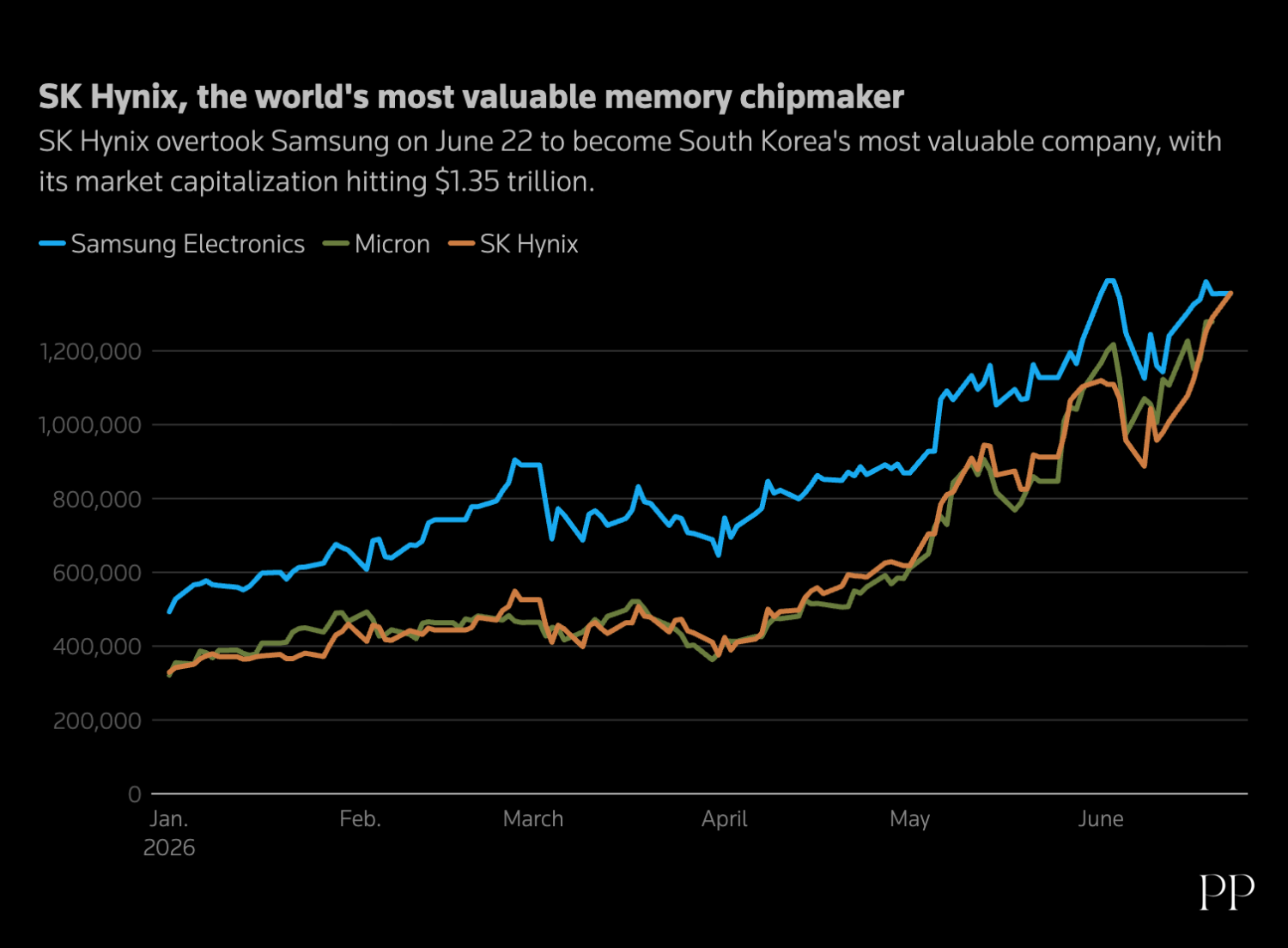
SK Hynix overtook Samsung Electronics on Monday to become South Korea's most valuable listed company, marking a remarkable turnaround for a chipmaker that was on the verge of collapse under mounting debt just over two decades ago.
Now the leading supplier of high-bandwidth memory (HBM) chips used in artificial intelligence systems for customers such as Nvidia and Google's parent company, Alphabet, SK Hynix has emerged as one of the biggest beneficiaries of the global AI boom. Its shares have surged more than 340% this year, pushing its market value above both Samsung Electronics and Micron Technology.
Shares of SK Hynix closed 5.6% higher, giving the company a market capitalisation of 2,080.4 trillion won ($1.35 trillion). Samsung Electronics, whose shares slipped 0.14%, ended the day with a market value of 2,066.7 trillion won, excluding preferred shares.
The rise of AI has fundamentally reshaped the global semiconductor industry, transforming specialised memory chips from low-margin commodities into essential infrastructure powering applications such as ChatGPT and advanced AI models.
 Unlike SK Hynix, which focuses primarily on memory chips, Samsung also manufactures logic chips and consumer electronics, including smartphones and televisions. Samsung had held the title of South Korea's most valuable company since 2000.
"The emergence of customised AI memory fundamentally changed the industry's economics and allowed SK Hynix to establish itself as the market leader," said Kim Sunwoo, senior analyst at Meritz Securities.
Samsung argued that its preferred shares should be included in any market capitalisation calculation. Including those shares, Samsung's market value stood at 2,246.4 trillion won at market close.
SK Hynix's rise represents one of the most dramatic corporate turnarounds in South Korean history.
In 2002, then-Hynix Semiconductor was close to being sold to Micron after aggressive expansion left the company overwhelmed by debt. The deal ultimately collapsed, and the company remained under creditor control for nearly a decade.
Its stock price fell to as low as 135 won in 2003, earning it a reputation as a penny stock, known in Korea as "Dongjeon-ju."
For years, its performance mirrored the memory industry's traditional boom-and-bust cycle. In 2023, a severe downturn in the semiconductor market pushed SK Hynix to an annual operating loss of 7.73 trillion won.
The company rebounded sharply as AI adoption accelerated. Heavy investments in AI infrastructure by Microsoft, Google, and Meta helped drive a recovery, enabling SK Hynix to report a record annual operating profit of 23.5 trillion won in 2024.
Analysts attribute SK Hynix's success to its decision to continue investing in HBM technology during one of the industry's worst downturns.
HBM chips, which stack memory vertically, deliver significantly faster performance and improved energy efficiency. Unlike conventional memory products, HBM is deeply integrated with AI processors, creating high barriers to entry and giving suppliers stronger pricing power.
By 2025, SK Hynix controlled 61% of the global HBM market, far ahead of Samsung's 17% and Micron's 21%.
Founded in 1983 as part of Hyundai, SK Hynix was later spun off and eventually acquired by SK Group, the family-controlled conglomerate with businesses spanning telecommunications, energy, and other industries.
SK Group Chairman Chey Tae-won, who faced significant opposition when pursuing the acquisition, explained his long-term vision in a book published earlier this year.
"What I really wanted to accomplish when we acquired Hynix was to transform it from a commodity memory producer into a mainstream semiconductor company whose products are indispensable," Chey wrote.
"In the past, it did not matter whether memory came from Hynix, Samsung, or Micron because the products were interchangeable. HBM is different. If SK Hynix's HBM is replaced with another product, an AI system may not function properly. What was once a peripheral component has become a core component."
Analysts also believe Samsung's leadership in the DRAM market is increasingly vulnerable.
According to Bank of America estimates, SK Hynix will produce approximately 589,000 DRAM wafers per month this year, compared with Samsung's 691,000 wafers. However, SK Hynix is expected to expand DRAM production by about 38% between 2025 and 2028, significantly outpacing Samsung's projected 17.5% growth.
That would reduce the production gap to less than 10% by 2028, down from roughly 23% in 2025 — a significant achievement given Samsung's much larger manufacturing base.
"Previously, Samsung's manufacturing scale made it nearly impossible for competitors to close the profitability gap," said Kim.
SK Hynix is also reportedly planning a U.S. listing on the Nasdaq, a move that could broaden its investor base and further strengthen its profile among global investors.
Unlike SK Hynix, which focuses primarily on memory chips, Samsung also manufactures logic chips and consumer electronics, including smartphones and televisions. Samsung had held the title of South Korea's most valuable company since 2000.
"The emergence of customised AI memory fundamentally changed the industry's economics and allowed SK Hynix to establish itself as the market leader," said Kim Sunwoo, senior analyst at Meritz Securities.
Samsung argued that its preferred shares should be included in any market capitalisation calculation. Including those shares, Samsung's market value stood at 2,246.4 trillion won at market close.
SK Hynix's rise represents one of the most dramatic corporate turnarounds in South Korean history.
In 2002, then-Hynix Semiconductor was close to being sold to Micron after aggressive expansion left the company overwhelmed by debt. The deal ultimately collapsed, and the company remained under creditor control for nearly a decade.
Its stock price fell to as low as 135 won in 2003, earning it a reputation as a penny stock, known in Korea as "Dongjeon-ju."
For years, its performance mirrored the memory industry's traditional boom-and-bust cycle. In 2023, a severe downturn in the semiconductor market pushed SK Hynix to an annual operating loss of 7.73 trillion won.
The company rebounded sharply as AI adoption accelerated. Heavy investments in AI infrastructure by Microsoft, Google, and Meta helped drive a recovery, enabling SK Hynix to report a record annual operating profit of 23.5 trillion won in 2024.
Analysts attribute SK Hynix's success to its decision to continue investing in HBM technology during one of the industry's worst downturns.
HBM chips, which stack memory vertically, deliver significantly faster performance and improved energy efficiency. Unlike conventional memory products, HBM is deeply integrated with AI processors, creating high barriers to entry and giving suppliers stronger pricing power.
By 2025, SK Hynix controlled 61% of the global HBM market, far ahead of Samsung's 17% and Micron's 21%.
Founded in 1983 as part of Hyundai, SK Hynix was later spun off and eventually acquired by SK Group, the family-controlled conglomerate with businesses spanning telecommunications, energy, and other industries.
SK Group Chairman Chey Tae-won, who faced significant opposition when pursuing the acquisition, explained his long-term vision in a book published earlier this year.
"What I really wanted to accomplish when we acquired Hynix was to transform it from a commodity memory producer into a mainstream semiconductor company whose products are indispensable," Chey wrote.
"In the past, it did not matter whether memory came from Hynix, Samsung, or Micron because the products were interchangeable. HBM is different. If SK Hynix's HBM is replaced with another product, an AI system may not function properly. What was once a peripheral component has become a core component."
Analysts also believe Samsung's leadership in the DRAM market is increasingly vulnerable.
According to Bank of America estimates, SK Hynix will produce approximately 589,000 DRAM wafers per month this year, compared with Samsung's 691,000 wafers. However, SK Hynix is expected to expand DRAM production by about 38% between 2025 and 2028, significantly outpacing Samsung's projected 17.5% growth.
That would reduce the production gap to less than 10% by 2028, down from roughly 23% in 2025 — a significant achievement given Samsung's much larger manufacturing base.
"Previously, Samsung's manufacturing scale made it nearly impossible for competitors to close the profitability gap," said Kim.
SK Hynix is also reportedly planning a U.S. listing on the Nasdaq, a move that could broaden its investor base and further strengthen its profile among global investors.