Tesla Q2 deliveries exceed analyst expectations
Image Credit : Reuters
Source Credit : Portfolio Prints
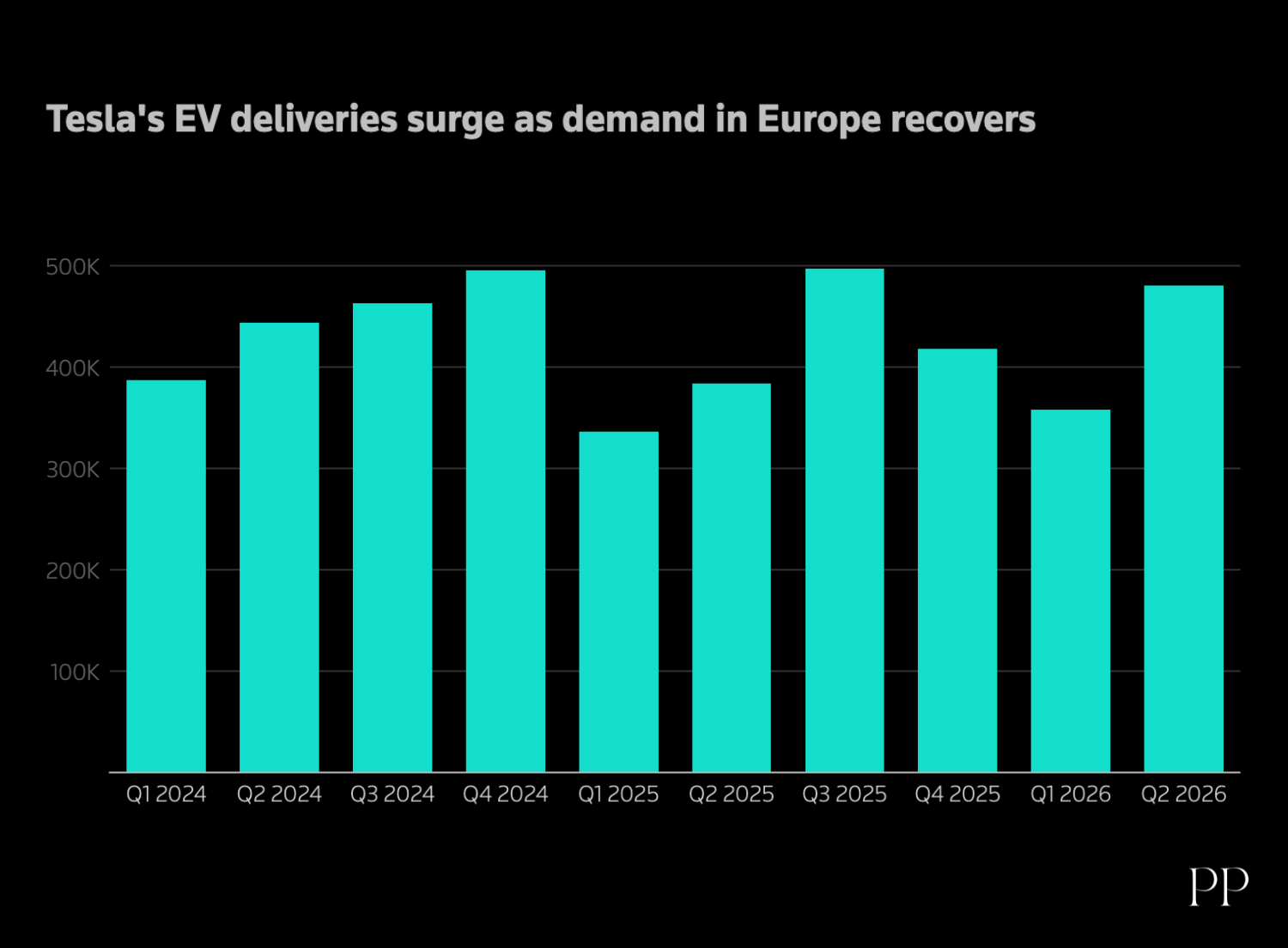
Tesla reported record second-quarter vehicle deliveries on Thursday, significantly surpassing Wall Street expectations as a strong recovery in Europe fueled optimism that the electric vehicle maker could end its two-year streak of annual sales declines in 2026.
The stronger-than-expected performance in Tesla's core automotive business provides an important boost as CEO Elon Musk continues investing heavily in autonomous driving and artificial intelligence—technologies that underpin much of the company's roughly $1.6 trillion market valuation.
Despite the positive delivery figures, Tesla shares fell about 7% in midday trading after gaining nearly 12% earlier in the week, suggesting investors had already priced in much of the optimism.
Europe emerged as Tesla's strongest growth market during the quarter, supported by higher fuel prices, renewed government incentives for electric vehicles, faster electrification of corporate fleets, and a gradual easing of consumer backlash linked to Elon Musk's political controversies last year.
 "I think the huge growth in Europe is the key driver for Tesla right now. U.S. sales still appear to be down, albeit less than the broader U.S. EV decline, while China is seeing small growth," said Seth Goldstein, senior equity analyst at Morningstar.
Goldstein, who had previously expected Tesla to post a third consecutive annual decline in deliveries, said the latest results make such an outcome increasingly unlikely. "I think it would be very hard to see a decline for the full year at this point," he said.
Tesla has supported demand by introducing lower-cost versions of its Model 3 sedan and Model Y SUV while offering attractive financing deals and purchase incentives.
"Their pricing and their products are helping buyers overcome any issues they might have with Elon Musk personally," said Sam Fiorani, vice president at AutoForecast Solutions.
However, demand in the United States—Tesla's largest market—remains under pressure following the removal of federal EV tax credits late last year. Fiorani said he remains "cautiously optimistic" that the company can still achieve modest growth during the year.
Analysts noted that the loss of purchase incentives continues to weigh on U.S. sales, although refreshed versions of Tesla's aging lineup have contributed to stronger demand in China.
"We believe Tesla's U.S. sales likely declined by at least 10% in the quarter," said Freedom Broker senior analyst Dmitriy Pozdnyakov.
Tesla also introduced the six-seat Model Y L in the U.S. on Thursday. The longer-wheelbase, three-row electric SUV has already helped drive deliveries in China and is expected to support demand in the American market.
The company delivered 480,126 vehicles during the April–June quarter, setting a new second-quarter record and representing a 25% increase from a year earlier. The figure comfortably exceeded analysts' consensus estimate of 402,776 deliveries, according to Visible Alpha.
Tesla produced 451,758 vehicles during the quarter, meaning deliveries exceeded production by more than 28,000 units. The gap indicates that the company reduced inventories accumulated during the first quarter.
China also remained a bright spot for Tesla, with sales of locally produced vehicles benefiting from the refreshed Model Y despite fierce competition from domestic manufacturers, including BYD.
Tesla will report its full second-quarter financial results on July 22 after the market closes.
Beyond its automotive business, Tesla continues to invest aggressively in future technologies. The company expects to spend more than $25 billion on capital expenditures in 2026—nearly triple last year's $8.5 billion—to expand AI infrastructure, battery manufacturing, Cybercab production, and development of its Optimus humanoid robots.
Tesla has also expanded the rollout of its Full Self-Driving (FSD) driver-assistance software across Europe, although the technology remains available in only a limited number of countries. Analysts expect broader deployment over the coming months to provide an additional boost to vehicle demand.
Meanwhile, the company has begun expanding its robotaxi operations following the launch of a limited commercial service in Austin in June. Musk has said Tesla intends to scale the service rapidly throughout 2026.
"The stock price is still riding a bit of a rollercoaster. Investors are excited about the rebound, but the bigger question remains whether Tesla can deliver on Elon Musk's ambitious promises around AI, robotaxis, and fully autonomous driving," said David Wagner, head of equity at Aptus Capital Advisors, a Tesla shareholder.
Production of the Cybercab—Tesla's purpose-built autonomous vehicle designed without pedals or a steering wheel—is expected to accelerate later this year.
Separately, electric vehicle startup Rivian also reported stronger-than-expected second-quarter deliveries on Thursday and raised its full-year delivery forecast, signaling broader resilience across parts of the EV market.
"I think the huge growth in Europe is the key driver for Tesla right now. U.S. sales still appear to be down, albeit less than the broader U.S. EV decline, while China is seeing small growth," said Seth Goldstein, senior equity analyst at Morningstar.
Goldstein, who had previously expected Tesla to post a third consecutive annual decline in deliveries, said the latest results make such an outcome increasingly unlikely. "I think it would be very hard to see a decline for the full year at this point," he said.
Tesla has supported demand by introducing lower-cost versions of its Model 3 sedan and Model Y SUV while offering attractive financing deals and purchase incentives.
"Their pricing and their products are helping buyers overcome any issues they might have with Elon Musk personally," said Sam Fiorani, vice president at AutoForecast Solutions.
However, demand in the United States—Tesla's largest market—remains under pressure following the removal of federal EV tax credits late last year. Fiorani said he remains "cautiously optimistic" that the company can still achieve modest growth during the year.
Analysts noted that the loss of purchase incentives continues to weigh on U.S. sales, although refreshed versions of Tesla's aging lineup have contributed to stronger demand in China.
"We believe Tesla's U.S. sales likely declined by at least 10% in the quarter," said Freedom Broker senior analyst Dmitriy Pozdnyakov.
Tesla also introduced the six-seat Model Y L in the U.S. on Thursday. The longer-wheelbase, three-row electric SUV has already helped drive deliveries in China and is expected to support demand in the American market.
The company delivered 480,126 vehicles during the April–June quarter, setting a new second-quarter record and representing a 25% increase from a year earlier. The figure comfortably exceeded analysts' consensus estimate of 402,776 deliveries, according to Visible Alpha.
Tesla produced 451,758 vehicles during the quarter, meaning deliveries exceeded production by more than 28,000 units. The gap indicates that the company reduced inventories accumulated during the first quarter.
China also remained a bright spot for Tesla, with sales of locally produced vehicles benefiting from the refreshed Model Y despite fierce competition from domestic manufacturers, including BYD.
Tesla will report its full second-quarter financial results on July 22 after the market closes.
Beyond its automotive business, Tesla continues to invest aggressively in future technologies. The company expects to spend more than $25 billion on capital expenditures in 2026—nearly triple last year's $8.5 billion—to expand AI infrastructure, battery manufacturing, Cybercab production, and development of its Optimus humanoid robots.
Tesla has also expanded the rollout of its Full Self-Driving (FSD) driver-assistance software across Europe, although the technology remains available in only a limited number of countries. Analysts expect broader deployment over the coming months to provide an additional boost to vehicle demand.
Meanwhile, the company has begun expanding its robotaxi operations following the launch of a limited commercial service in Austin in June. Musk has said Tesla intends to scale the service rapidly throughout 2026.
"The stock price is still riding a bit of a rollercoaster. Investors are excited about the rebound, but the bigger question remains whether Tesla can deliver on Elon Musk's ambitious promises around AI, robotaxis, and fully autonomous driving," said David Wagner, head of equity at Aptus Capital Advisors, a Tesla shareholder.
Production of the Cybercab—Tesla's purpose-built autonomous vehicle designed without pedals or a steering wheel—is expected to accelerate later this year.
Separately, electric vehicle startup Rivian also reported stronger-than-expected second-quarter deliveries on Thursday and raised its full-year delivery forecast, signaling broader resilience across parts of the EV market.