BlackRock assets hit record $15 Trillion
Image Credit : Reuters
Source Credit : Portfolio Prints
BlackRock delivered a stronger-than-expected second quarter, benefiting from a powerful rally in global equity markets and robust investor demand for its exchange-traded funds (ETFs). The results pushed the asset manager's shares up roughly 6% in premarket trading after the company reported earnings that comfortably exceeded Wall Street expectations.
Assets under management (AUM) climbed to a record $15.34 trillion, marking a significant increase from $12.53 trillion a year earlier and $13.89 trillion in the previous quarter. The growth was fueled by both rising market valuations and substantial client inflows, underscoring BlackRock's ability to attract capital across diverse market environments.
The quarter coincided with a strong rebound in U.S. equity markets. Major stock indexes ended June with their strongest quarterly performance since 2020 as investors grew increasingly optimistic about corporate earnings, resilient economic growth, and the long-term impact of emerging technologies. The benchmark S&P 500 rose approximately 15% during the period, providing a powerful tailwind for asset managers whose revenues are closely tied to market values.
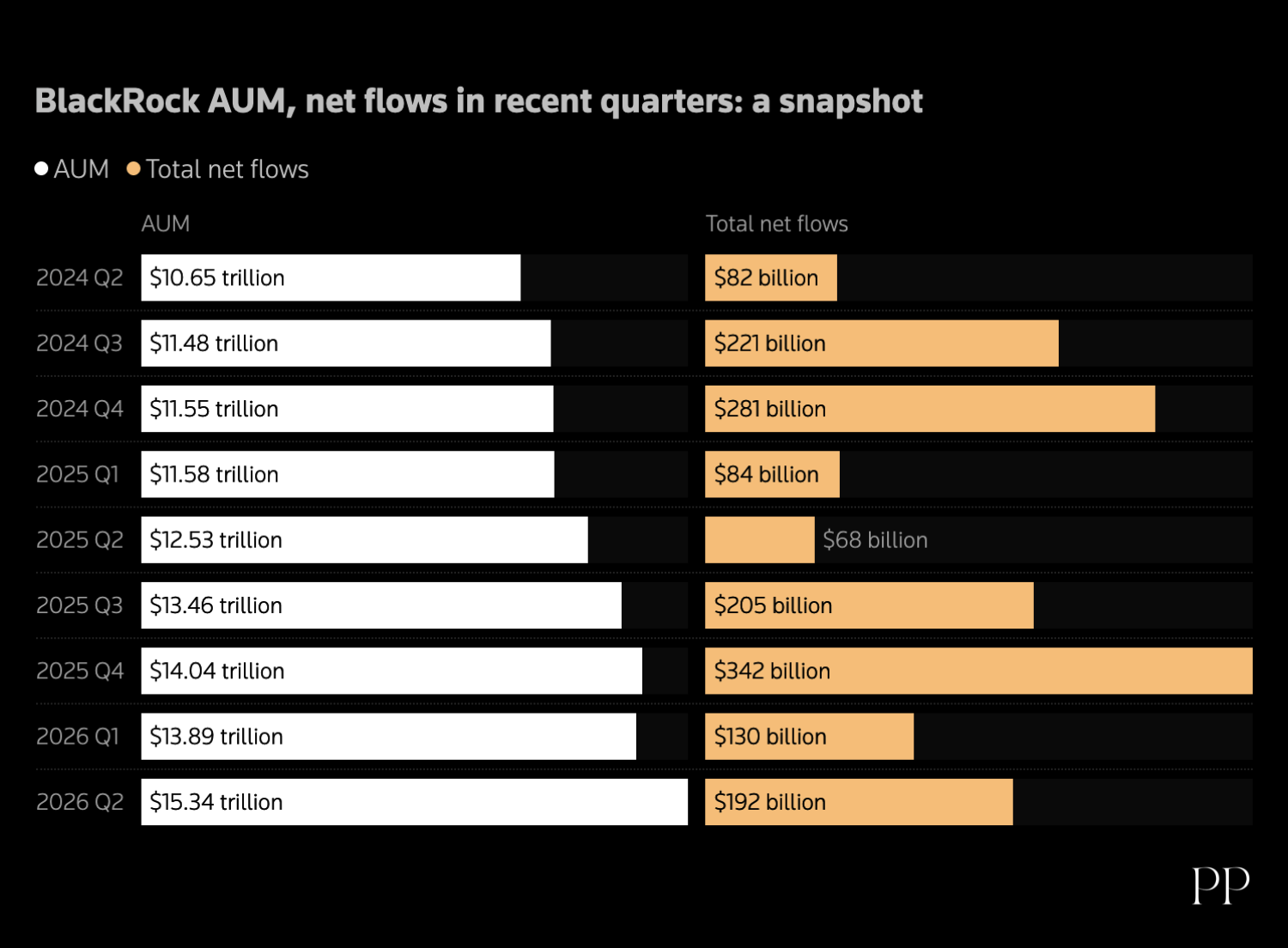 BlackRock, the world's largest asset manager, attracted $192 billion in net client inflows during the quarter, significantly outperforming the $68 billion recorded a year earlier and the $130 billion generated in the first quarter. The firm's industry-leading iShares ETF platform remained a major growth engine, reflecting continued investor preference for low-cost, diversified investment vehicles.
Equity strategies contributed $71.6 billion of net inflows, while fixed-income products generated an even stronger $92 billion, highlighting sustained demand for bonds despite ongoing uncertainty surrounding interest rates and monetary policy.
Commenting on the results, Chief Executive Officer Larry Fink emphasized the strength of the current investment environment and the role of technological innovation in supporting corporate profitability.
“Market fundamentals are strong and well supported, with higher margins and earnings momentum catalyzed by new technology. The scale and depth of our client relationships globally have never been greater,” Fink said.
On an adjusted basis, BlackRock reported earnings of $13.91 per share for the three months ended June 30, surpassing analyst expectations of $12.59 per share. The company also signaled confidence in its future prospects by increasing its planned 2026 share repurchase program to $2 billion from the previously announced $1.8 billion.
While BlackRock has traditionally been known for its dominance in public equity and fixed-income markets, the firm has spent the past several years aggressively expanding its presence in alternative investments. This strategic shift reflects a broader industry trend as asset managers seek higher-fee businesses that are less dependent on public market performance.
To accelerate its transformation, BlackRock has invested approximately $28 billion in acquisitions, including infrastructure specialist Global Infrastructure Partners (GIP), private credit manager HPS Investment Partners, and financial data provider Preqin. These deals have substantially strengthened the firm's capabilities across private markets and alternative assets.
Despite the long-term growth opportunity, the private credit sector has recently come under heightened scrutiny. Regulators and investors have raised concerns about lending standards, liquidity risks, and the potential impact of artificial intelligence on certain corporate borrowers, particularly within the software industry.
Investor caution has been reflected in retail-oriented private credit vehicles. BlackRock's HPS Corporate Lending Fund (HLEND), one of the firm's flagship non-traded private credit funds, experienced elevated redemption requests during the quarter. Investors sought to withdraw approximately 13.3% of shares, prompting the fund to maintain its standard quarterly redemption limit of 5%.
Nevertheless, BlackRock's private markets platform continued to generate positive inflows. Private credit strategies attracted $6 billion during the quarter, while infrastructure investments brought in an additional $5.2 billion. Total private markets net inflows reached $15.4 billion, demonstrating continued institutional interest despite broader concerns surrounding the asset class.
Fink has repeatedly emphasized that demand from institutional investors remains strong and that recent market concerns have done little to alter long-term capital allocation trends. Reflecting this confidence, BlackRock has established an ambitious goal of raising $400 billion in gross private markets capital between 2025 and 2030.
The strategic importance of private markets extends beyond asset growth. Alternative investments typically generate substantially higher management fees than ETFs, which remain a cornerstone of BlackRock's business through its market-leading iShares franchise. As a result, continued expansion in private credit, infrastructure, and other alternative asset classes is expected to play a central role in the firm's long-term revenue and profitability growth.
BlackRock, the world's largest asset manager, attracted $192 billion in net client inflows during the quarter, significantly outperforming the $68 billion recorded a year earlier and the $130 billion generated in the first quarter. The firm's industry-leading iShares ETF platform remained a major growth engine, reflecting continued investor preference for low-cost, diversified investment vehicles.
Equity strategies contributed $71.6 billion of net inflows, while fixed-income products generated an even stronger $92 billion, highlighting sustained demand for bonds despite ongoing uncertainty surrounding interest rates and monetary policy.
Commenting on the results, Chief Executive Officer Larry Fink emphasized the strength of the current investment environment and the role of technological innovation in supporting corporate profitability.
“Market fundamentals are strong and well supported, with higher margins and earnings momentum catalyzed by new technology. The scale and depth of our client relationships globally have never been greater,” Fink said.
On an adjusted basis, BlackRock reported earnings of $13.91 per share for the three months ended June 30, surpassing analyst expectations of $12.59 per share. The company also signaled confidence in its future prospects by increasing its planned 2026 share repurchase program to $2 billion from the previously announced $1.8 billion.
While BlackRock has traditionally been known for its dominance in public equity and fixed-income markets, the firm has spent the past several years aggressively expanding its presence in alternative investments. This strategic shift reflects a broader industry trend as asset managers seek higher-fee businesses that are less dependent on public market performance.
To accelerate its transformation, BlackRock has invested approximately $28 billion in acquisitions, including infrastructure specialist Global Infrastructure Partners (GIP), private credit manager HPS Investment Partners, and financial data provider Preqin. These deals have substantially strengthened the firm's capabilities across private markets and alternative assets.
Despite the long-term growth opportunity, the private credit sector has recently come under heightened scrutiny. Regulators and investors have raised concerns about lending standards, liquidity risks, and the potential impact of artificial intelligence on certain corporate borrowers, particularly within the software industry.
Investor caution has been reflected in retail-oriented private credit vehicles. BlackRock's HPS Corporate Lending Fund (HLEND), one of the firm's flagship non-traded private credit funds, experienced elevated redemption requests during the quarter. Investors sought to withdraw approximately 13.3% of shares, prompting the fund to maintain its standard quarterly redemption limit of 5%.
Nevertheless, BlackRock's private markets platform continued to generate positive inflows. Private credit strategies attracted $6 billion during the quarter, while infrastructure investments brought in an additional $5.2 billion. Total private markets net inflows reached $15.4 billion, demonstrating continued institutional interest despite broader concerns surrounding the asset class.
Fink has repeatedly emphasized that demand from institutional investors remains strong and that recent market concerns have done little to alter long-term capital allocation trends. Reflecting this confidence, BlackRock has established an ambitious goal of raising $400 billion in gross private markets capital between 2025 and 2030.
The strategic importance of private markets extends beyond asset growth. Alternative investments typically generate substantially higher management fees than ETFs, which remain a cornerstone of BlackRock's business through its market-leading iShares franchise. As a result, continued expansion in private credit, infrastructure, and other alternative asset classes is expected to play a central role in the firm's long-term revenue and profitability growth.