Nvidia forecasts 70% sales growth next year
Image Credit : Bloomberg
Source Credit : Portfolio Prints
Nvidia delivered another strong outlook for artificial intelligence spending on Wednesday, forecasting a 70% increase in revenue for its next fiscal year. The projection highlights the extraordinary demand for AI computing infrastructure, while the company warned that shortages of memory and other components could limit how quickly it can expand.
Nvidia shares rose nearly 5% in extended trading after initially falling more than 1%, as investors focused on the company’s unusually strong long-term growth forecast. The outlook provided fresh reassurance to investors who have increasingly questioned whether the multiyear AI investment boom can continue at its current pace.
Chief Executive Jensen Huang argued that AI has reached a critical turning point as companies increasingly use the technology for productive and profitable applications. In Nvidia’s view, growing AI adoption is translating directly into demand for computing power, turning the expansion of AI infrastructure into a major source of revenue.
Nvidia’s forecast calls for revenue growth of about 70% in the fiscal year ending January 2028. The projection is particularly notable because the company rarely provides financial guidance so far into the future. Analysts had been expecting revenue growth of roughly 44% over the same period, making Nvidia’s outlook significantly more optimistic than Wall Street’s expectations.
The forecast also suggests that Nvidia believes the AI chip market is expanding rather than approaching a peak. Demand is increasingly coming from a broader group of customers, including major technology companies, AI laboratories, cloud providers, enterprises, governments and industrial businesses.
 Nvidia executives also provided a roadmap for continued expansion, including the rollout of its next-generation Vera Rubin computing platform and growing sales to AI laboratories such as OpenAI. The company said its Vera Rubin platform has already begun shipping to customers and is expected to account for roughly one-fifth of its data-center revenue in the current quarter ending in October.
The strength of Nvidia’s existing business provides a foundation for that growth. Data-center revenue more than doubled in the fiscal second quarter ended July, reaching $89 billion and exceeding analysts’ expectations of $85.08 billion.
Nvidia also expects AI laboratories to become an increasingly important source of revenue. The company estimates that demand from AI labs could represent roughly one-quarter of its overall business next year, suggesting that its customer base is becoming more diversified beyond the largest cloud and technology companies.
Another rapidly expanding customer group is the so-called neo-cloud sector, which includes specialized cloud providers such as Nebius and CoreWeave. Nvidia said these companies are expected to finish the year with more than eight gigawatts of Nvidia GPU capacity, compared with around three gigawatts at the end of last year.
The company is also deepening its relationship with Amazon Web Services. Nvidia and AWS plan to deploy an additional two million Nvidia graphics processors across Amazon’s global infrastructure during 2027 and 2028, highlighting the scale of computing capacity that cloud providers are preparing for the next phase of AI demand.
Despite the strength of demand, Nvidia faces an important constraint: it cannot expand supply as quickly as customers want. Chief Financial Officer Colette Kress said customer forecasts suggest that Nvidia’s growth could effectively double next year, but the company remains constrained by the availability of components.
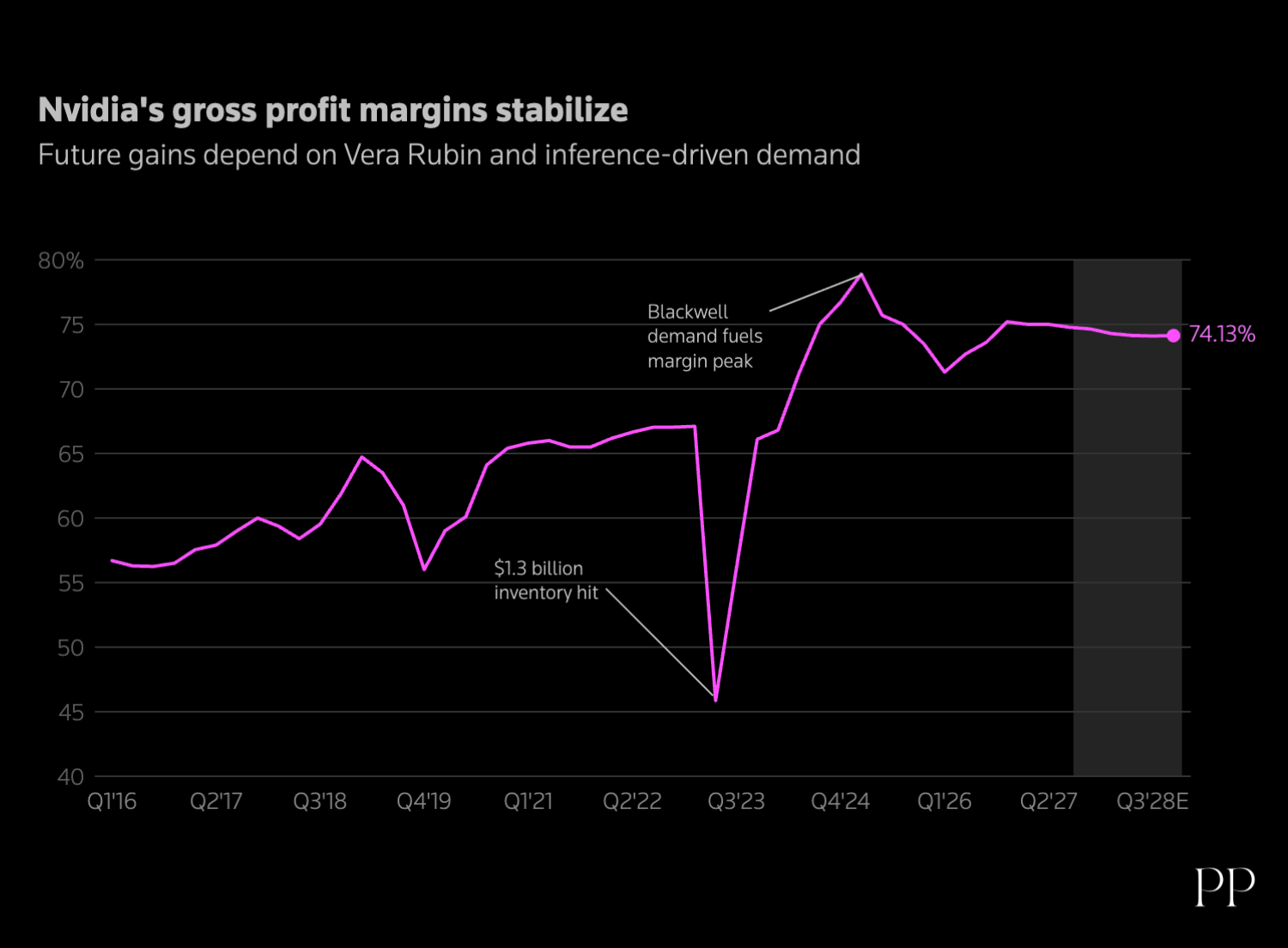
Memory shortages are becoming a particularly important challenge. Surging memory prices and higher component costs are expected to put pressure on Nvidia’s profit margins. The company expects margins to fall to roughly 71%–72% in the fourth quarter, compared with about 74% in the third quarter.
Even with those cost pressures, Nvidia’s near-term outlook remains stronger than analysts had expected. The company forecast third-quarter revenue of approximately $108 billion, with a possible variation of 2% in either direction. Analysts had been expecting about $104.19 billion.
Nvidia’s latest quarterly results also surpassed expectations. Revenue for the second quarter rose more than 50% to $96.22 billion, compared with analysts’ forecast of $92.17 billion. Adjusted earnings reached $2.22 per share, ahead of the $2.10 expected by analysts.
China remains one of the biggest uncertainties surrounding Nvidia’s future growth. U.S. export restrictions have made the company’s access to the Chinese AI market increasingly unpredictable. Although Washington previously cleared several Chinese companies, including Alibaba, Tencent and ByteDance, to purchase Nvidia’s powerful H200 chips, deliveries were delayed for months.
Nvidia did not include revenue from China’s data-center market in its latest outlook, reflecting the uncertainty surrounding future sales. The company has nevertheless continued efforts to serve Chinese customers, including promoting its new Vera CPU and exploring opportunities to supply advanced computing products within the limits of U.S. export controls.
The latest results reinforce Nvidia’s position at the center of the global AI infrastructure boom. The company is benefiting from enormous demand for GPUs and increasingly sophisticated computing systems, while its expanding customer base and new product generations provide additional avenues for growth.
However, Nvidia’s biggest challenge may no longer be finding customers. It is producing enough chips and securing enough memory and other components to meet demand. If those supply constraints ease, the company could capture even more of the rapidly expanding AI infrastructure market. If shortages persist, they could become one of the main factors limiting Nvidia’s ability to turn unprecedented demand into even faster revenue growth.
Nvidia executives also provided a roadmap for continued expansion, including the rollout of its next-generation Vera Rubin computing platform and growing sales to AI laboratories such as OpenAI. The company said its Vera Rubin platform has already begun shipping to customers and is expected to account for roughly one-fifth of its data-center revenue in the current quarter ending in October.
The strength of Nvidia’s existing business provides a foundation for that growth. Data-center revenue more than doubled in the fiscal second quarter ended July, reaching $89 billion and exceeding analysts’ expectations of $85.08 billion.
Nvidia also expects AI laboratories to become an increasingly important source of revenue. The company estimates that demand from AI labs could represent roughly one-quarter of its overall business next year, suggesting that its customer base is becoming more diversified beyond the largest cloud and technology companies.
Another rapidly expanding customer group is the so-called neo-cloud sector, which includes specialized cloud providers such as Nebius and CoreWeave. Nvidia said these companies are expected to finish the year with more than eight gigawatts of Nvidia GPU capacity, compared with around three gigawatts at the end of last year.
The company is also deepening its relationship with Amazon Web Services. Nvidia and AWS plan to deploy an additional two million Nvidia graphics processors across Amazon’s global infrastructure during 2027 and 2028, highlighting the scale of computing capacity that cloud providers are preparing for the next phase of AI demand.
Despite the strength of demand, Nvidia faces an important constraint: it cannot expand supply as quickly as customers want. Chief Financial Officer Colette Kress said customer forecasts suggest that Nvidia’s growth could effectively double next year, but the company remains constrained by the availability of components.
Memory shortages are becoming a particularly important challenge. Surging memory prices and higher component costs are expected to put pressure on Nvidia’s profit margins. The company expects margins to fall to roughly 71%–72% in the fourth quarter, compared with about 74% in the third quarter.
Even with those cost pressures, Nvidia’s near-term outlook remains stronger than analysts had expected. The company forecast third-quarter revenue of approximately $108 billion, with a possible variation of 2% in either direction. Analysts had been expecting about $104.19 billion.
Nvidia’s latest quarterly results also surpassed expectations. Revenue for the second quarter rose more than 50% to $96.22 billion, compared with analysts’ forecast of $92.17 billion. Adjusted earnings reached $2.22 per share, ahead of the $2.10 expected by analysts.
China remains one of the biggest uncertainties surrounding Nvidia’s future growth. U.S. export restrictions have made the company’s access to the Chinese AI market increasingly unpredictable. Although Washington previously cleared several Chinese companies, including Alibaba, Tencent and ByteDance, to purchase Nvidia’s powerful H200 chips, deliveries were delayed for months.
Nvidia did not include revenue from China’s data-center market in its latest outlook, reflecting the uncertainty surrounding future sales. The company has nevertheless continued efforts to serve Chinese customers, including promoting its new Vera CPU and exploring opportunities to supply advanced computing products within the limits of U.S. export controls.
The latest results reinforce Nvidia’s position at the center of the global AI infrastructure boom. The company is benefiting from enormous demand for GPUs and increasingly sophisticated computing systems, while its expanding customer base and new product generations provide additional avenues for growth.
However, Nvidia’s biggest challenge may no longer be finding customers. It is producing enough chips and securing enough memory and other components to meet demand. If those supply constraints ease, the company could capture even more of the rapidly expanding AI infrastructure market. If shortages persist, they could become one of the main factors limiting Nvidia’s ability to turn unprecedented demand into even faster revenue growth.