Reserve Bank of India held its policy rate steady on Friday
Image Credit : Bloomberg
Source Credit : Portfolio Prints
The Reserve Bank of India left interest rates unchanged on Friday while unveiling a package of measures aimed at attracting foreign capital and strengthening the rupee, as the economy faces mounting pressure from elevated oil prices and persistent capital outflows following the Iran war.
The central bank announced a series of initiatives designed to boost dollar inflows, including the removal of capital gains taxes on government bond investments by foreign investors, enhanced incentives for non-resident Indian (NRI) dollar deposits, and support for hedging costs on overseas borrowings.
The RBI's Monetary Policy Committee unanimously voted to keep the benchmark repo rate unchanged at 5.25%, a move anticipated by nearly 80% of the 56 economists surveyed by Reuters. Policymakers also retained the central bank's "neutral" policy stance.
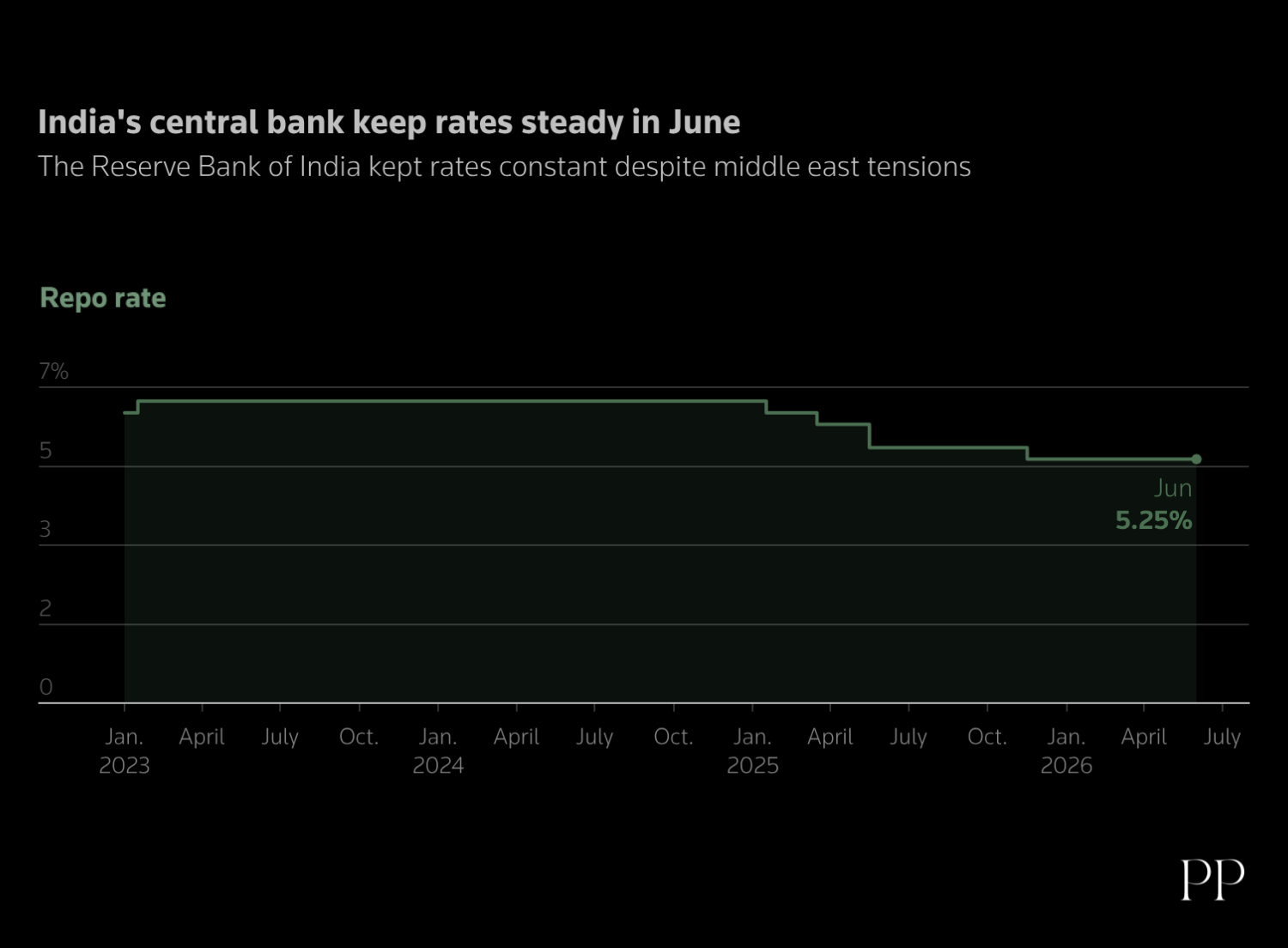 "The global economic environment has become more challenging," RBI Governor Sanjay Malhotra said while announcing the policy decision. Given heightened uncertainty, the committee considered it prudent to wait for greater clarity before altering its policy course.
Although inflation is expected to rise in the coming months, Malhotra said underlying price pressures remain contained. However, he cautioned that potential second-round effects from higher costs would require close monitoring.
Financial markets reacted positively to the announcement. India's benchmark 10-year government bond yield edged lower to 6.96%, while the rupee strengthened 0.35% to 95.48 per U.S. dollar. Equity benchmarks extended early gains, rising about 0.2%.
The rupee has come under significant pressure since the Gulf conflict intensified in late February. A sharp rise in crude oil prices and record foreign fund outflows have pushed the currency down nearly 5%, driving it to historic lows and prompting some analysts to advocate higher interest rates to defend the currency.
Across Asia, several central banks have already moved to support their currencies. Indonesia, the Philippines, and Sri Lanka have raised rates in recent weeks, while South Korea has signaled that tighter monetary policy could be on the horizon.
Rather than tightening policy and risking a slowdown in economic growth, Indian policymakers opted to maintain rates while deploying targeted measures to support the currency.
In coordination with the RBI's announcement, the government said it would abolish capital gains taxes on foreign investments in government securities and eliminate the 20% tax on interest income earned from such investments, effective April 1, 2026.
Currently, foreign investors face a 12.5% long-term capital gains tax on listed shares and bonds held for more than one year.
Separately, the RBI announced concessional foreign-exchange swap facilities through September 30 to encourage state-owned companies to raise funds through overseas dollar borrowings.
The central bank will also compensate banks for hedging costs associated with three-year and five-year foreign currency non-resident (FCNR) deposits, a move aimed at attracting more funds from the Indian diaspora.
Taken together, the measures could generate between $40 billion and $60 billion in additional inflows, according to Sachchidanand Shukla, Group Chief Economist at Larsen & Toubro.
The rupee has now fallen roughly 5% this year after a similar decline in 2025. Economists warn that sustained oil price pressures and continued foreign capital outflows could widen India's balance of payments deficit to around $65 billion during the current fiscal year.
The RBI also revised its macroeconomic forecasts.
Average retail inflation for the fiscal year is now projected at 5.1%, up from the previous estimate of 4.6%, while core inflation is expected to average 4.7%, compared with an earlier forecast of 4.4%.
Despite the upward revision, inflation is expected to remain within the RBI's target tolerance band of 2% to 6%, giving policymakers room to keep interest rates steady for now.
Economic growth, however, is expected to slow modestly. The RBI lowered its GDP growth forecast for the current fiscal year to 6.6% from 6.9% projected in April. By comparison, India's economy is estimated to have expanded 7.6% in the fiscal year ended March 31, 2026.
Malhotra warned that a weaker-than-expected monsoon and a deteriorating global economic outlook could pose additional risks to growth.
Nevertheless, recent economic indicators continue to point to resilience. Industrial production data and purchasing managers' surveys suggest business activity remains on a stable footing.
Many economists believe rising inflationary pressures will eventually force the central bank to tighten policy later this year.
"Given the RBI's emphasis on heightened inflation risks, we expect cumulative rate hikes of 50 basis points beginning in October," said Upasna Bhardwaj, Chief Economist at Kotak Mahindra Bank.
"The global economic environment has become more challenging," RBI Governor Sanjay Malhotra said while announcing the policy decision. Given heightened uncertainty, the committee considered it prudent to wait for greater clarity before altering its policy course.
Although inflation is expected to rise in the coming months, Malhotra said underlying price pressures remain contained. However, he cautioned that potential second-round effects from higher costs would require close monitoring.
Financial markets reacted positively to the announcement. India's benchmark 10-year government bond yield edged lower to 6.96%, while the rupee strengthened 0.35% to 95.48 per U.S. dollar. Equity benchmarks extended early gains, rising about 0.2%.
The rupee has come under significant pressure since the Gulf conflict intensified in late February. A sharp rise in crude oil prices and record foreign fund outflows have pushed the currency down nearly 5%, driving it to historic lows and prompting some analysts to advocate higher interest rates to defend the currency.
Across Asia, several central banks have already moved to support their currencies. Indonesia, the Philippines, and Sri Lanka have raised rates in recent weeks, while South Korea has signaled that tighter monetary policy could be on the horizon.
Rather than tightening policy and risking a slowdown in economic growth, Indian policymakers opted to maintain rates while deploying targeted measures to support the currency.
In coordination with the RBI's announcement, the government said it would abolish capital gains taxes on foreign investments in government securities and eliminate the 20% tax on interest income earned from such investments, effective April 1, 2026.
Currently, foreign investors face a 12.5% long-term capital gains tax on listed shares and bonds held for more than one year.
Separately, the RBI announced concessional foreign-exchange swap facilities through September 30 to encourage state-owned companies to raise funds through overseas dollar borrowings.
The central bank will also compensate banks for hedging costs associated with three-year and five-year foreign currency non-resident (FCNR) deposits, a move aimed at attracting more funds from the Indian diaspora.
Taken together, the measures could generate between $40 billion and $60 billion in additional inflows, according to Sachchidanand Shukla, Group Chief Economist at Larsen & Toubro.
The rupee has now fallen roughly 5% this year after a similar decline in 2025. Economists warn that sustained oil price pressures and continued foreign capital outflows could widen India's balance of payments deficit to around $65 billion during the current fiscal year.
The RBI also revised its macroeconomic forecasts.
Average retail inflation for the fiscal year is now projected at 5.1%, up from the previous estimate of 4.6%, while core inflation is expected to average 4.7%, compared with an earlier forecast of 4.4%.
Despite the upward revision, inflation is expected to remain within the RBI's target tolerance band of 2% to 6%, giving policymakers room to keep interest rates steady for now.
Economic growth, however, is expected to slow modestly. The RBI lowered its GDP growth forecast for the current fiscal year to 6.6% from 6.9% projected in April. By comparison, India's economy is estimated to have expanded 7.6% in the fiscal year ended March 31, 2026.
Malhotra warned that a weaker-than-expected monsoon and a deteriorating global economic outlook could pose additional risks to growth.
Nevertheless, recent economic indicators continue to point to resilience. Industrial production data and purchasing managers' surveys suggest business activity remains on a stable footing.
Many economists believe rising inflationary pressures will eventually force the central bank to tighten policy later this year.
"Given the RBI's emphasis on heightened inflation risks, we expect cumulative rate hikes of 50 basis points beginning in October," said Upasna Bhardwaj, Chief Economist at Kotak Mahindra Bank.