US to invest $2 billion in IBM and nine other firms
Image Credit : The New York Times
Source Credit : Portfolio Prints
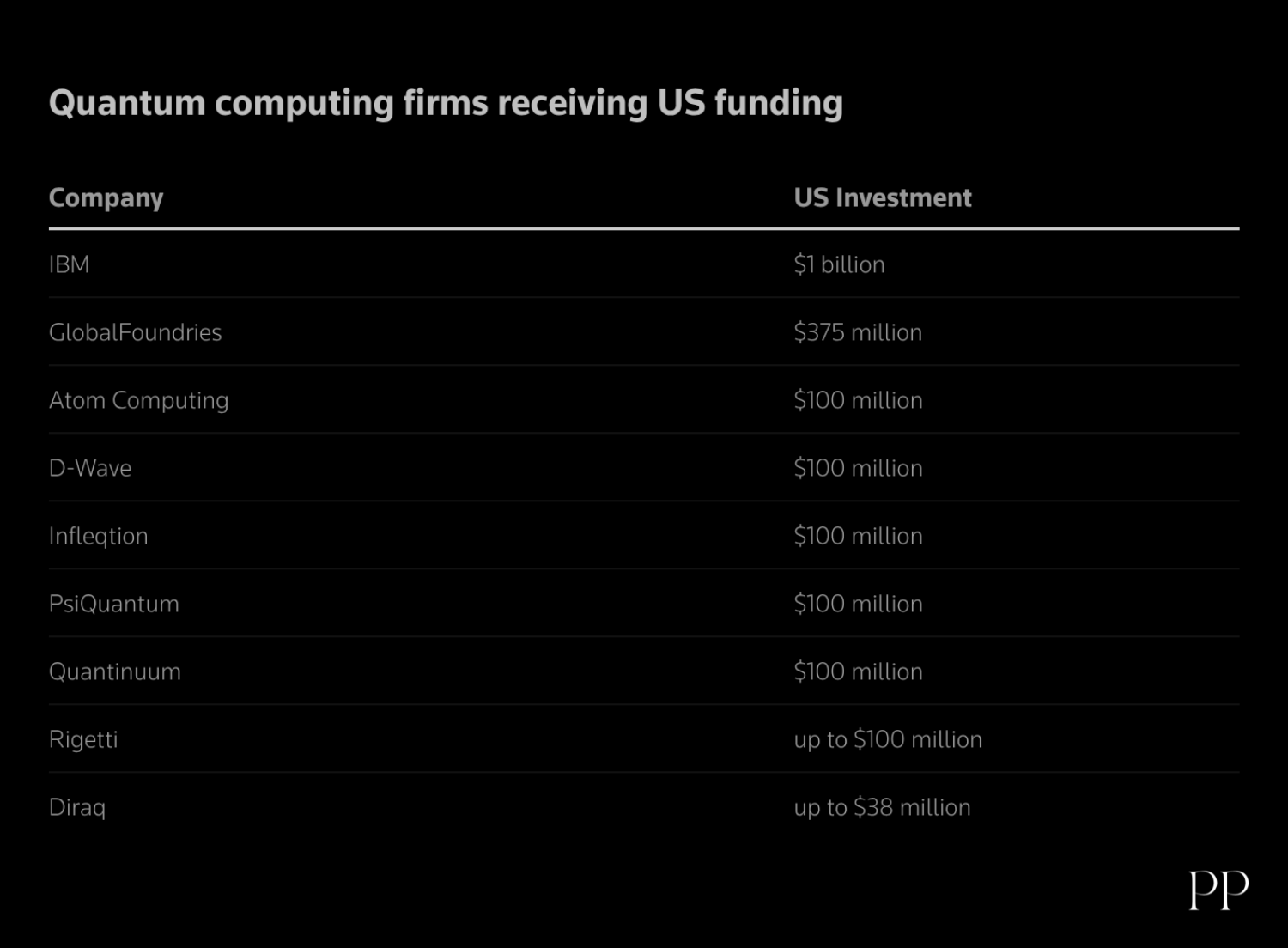
The Trump administration will take roughly $2 billion in equity stakes across nine quantum-computing companies — including a new venture by IBM — in a sweeping effort to cement U.S. leadership in the next generation of computing technology and counter China’s growing influence in the sector.
The move highlights the rapidly rising importance of quantum computing, where recent breakthroughs have intensified investor enthusiasm over its potential to transform industries ranging from drug discovery and financial modeling to cybersecurity and cryptography.
The U.S. Department of Commerce announced on Thursday that IBM will receive $1 billion to launch a company focused on manufacturing quantum chips, while contract chipmaker GlobalFoundries will receive $375 million to build a U.S.-based facility producing key components for multiple types of quantum systems.
IBM said the new company, Anderon, will be headquartered in New Albany, New York, and become the first dedicated quantum-chip manufacturing facility in the United States. The company did not disclose the size of the government’s equity stake.
IBM CEO Arvind Krishna told Reuters that Anderon would also provide its chipmaking technology to external customers and was already in discussions with potential partners.
“They’re going to get the exact same capability that we have for ourselves,” Krishna said.
Other companies set to benefit from the funding include D-Wave Quantum, Rigetti Computing, and Infleqtion, each of which will receive around $100 million. Australian startup Diraq will receive up to $38 million to address key technical barriers limiting the development of more powerful quantum systems, the Commerce Department said.
 Two of the companies involved also have ties to the administration. Emil Michael, currently the Pentagon’s top technology official, took D-Wave public in 2022 through a blank-check company he led at the time. Meanwhile, PsiQuantum raised $1 billion last year from investors that included Nvidia’s venture arm and Donald Trump Jr.-backed 1789 Capital.
Shares of companies tied to the initiative surged between 6% and 31% following the announcement, reflecting growing investor optimism surrounding the sector.
The funding, which comes from incentives created under the CHIPS and Science Act signed by former President Joe Biden, marks another example of Washington taking direct equity positions in strategic industries to strengthen domestic supply chains and compete more aggressively with China.
Last year, the U.S. government converted portions of CHIPS Act grants and unpaid federal incentives into a 10% stake in Intel, making it the company’s largest shareholder. Washington has also acquired a major stake in MP Materials, a key player in the rare-earth supply chain.
“These strategic quantum technology investments will build on our domestic industry, creating thousands of high-paying American jobs while advancing American quantum capabilities,” Secretary of Commerce Howard Lutnick said.
Quantum computing has attracted growing global attention after a series of technological advances in recent years, though the industry still faces major engineering challenges, including high error rates that limit real-world performance and scalability.
IBM said it will contribute an additional $1 billion directly into Anderon, alongside intellectual property, existing assets, and workforce resources. The company also plans to bring in outside investors as the venture expands.
GlobalFoundries, in which the U.S. government is expected to take an equity stake of roughly 1%, said it has launched a new division called Quantum Technology Solutions to help scale manufacturing for quantum-computing hardware.
Gregg Bartlett, chief technology officer at GlobalFoundries, told Reuters the company plans to work with multiple partners on specialized control chips capable of operating at the ultra-low temperatures required for quantum computers, as well as advanced packaging technologies.
Matthew Kinsella, CEO of Infleqtion, said the investments demonstrate that quantum computing is increasingly being viewed as commercially viable rather than speculative.
“The government has proven not to fund technologies they view as speculative,” Kinsella said. “I believe this investment further validates that quantum computing is arriving much faster than most people expect.”
Two of the companies involved also have ties to the administration. Emil Michael, currently the Pentagon’s top technology official, took D-Wave public in 2022 through a blank-check company he led at the time. Meanwhile, PsiQuantum raised $1 billion last year from investors that included Nvidia’s venture arm and Donald Trump Jr.-backed 1789 Capital.
Shares of companies tied to the initiative surged between 6% and 31% following the announcement, reflecting growing investor optimism surrounding the sector.
The funding, which comes from incentives created under the CHIPS and Science Act signed by former President Joe Biden, marks another example of Washington taking direct equity positions in strategic industries to strengthen domestic supply chains and compete more aggressively with China.
Last year, the U.S. government converted portions of CHIPS Act grants and unpaid federal incentives into a 10% stake in Intel, making it the company’s largest shareholder. Washington has also acquired a major stake in MP Materials, a key player in the rare-earth supply chain.
“These strategic quantum technology investments will build on our domestic industry, creating thousands of high-paying American jobs while advancing American quantum capabilities,” Secretary of Commerce Howard Lutnick said.
Quantum computing has attracted growing global attention after a series of technological advances in recent years, though the industry still faces major engineering challenges, including high error rates that limit real-world performance and scalability.
IBM said it will contribute an additional $1 billion directly into Anderon, alongside intellectual property, existing assets, and workforce resources. The company also plans to bring in outside investors as the venture expands.
GlobalFoundries, in which the U.S. government is expected to take an equity stake of roughly 1%, said it has launched a new division called Quantum Technology Solutions to help scale manufacturing for quantum-computing hardware.
Gregg Bartlett, chief technology officer at GlobalFoundries, told Reuters the company plans to work with multiple partners on specialized control chips capable of operating at the ultra-low temperatures required for quantum computers, as well as advanced packaging technologies.
Matthew Kinsella, CEO of Infleqtion, said the investments demonstrate that quantum computing is increasingly being viewed as commercially viable rather than speculative.
“The government has proven not to fund technologies they view as speculative,” Kinsella said. “I believe this investment further validates that quantum computing is arriving much faster than most people expect.”