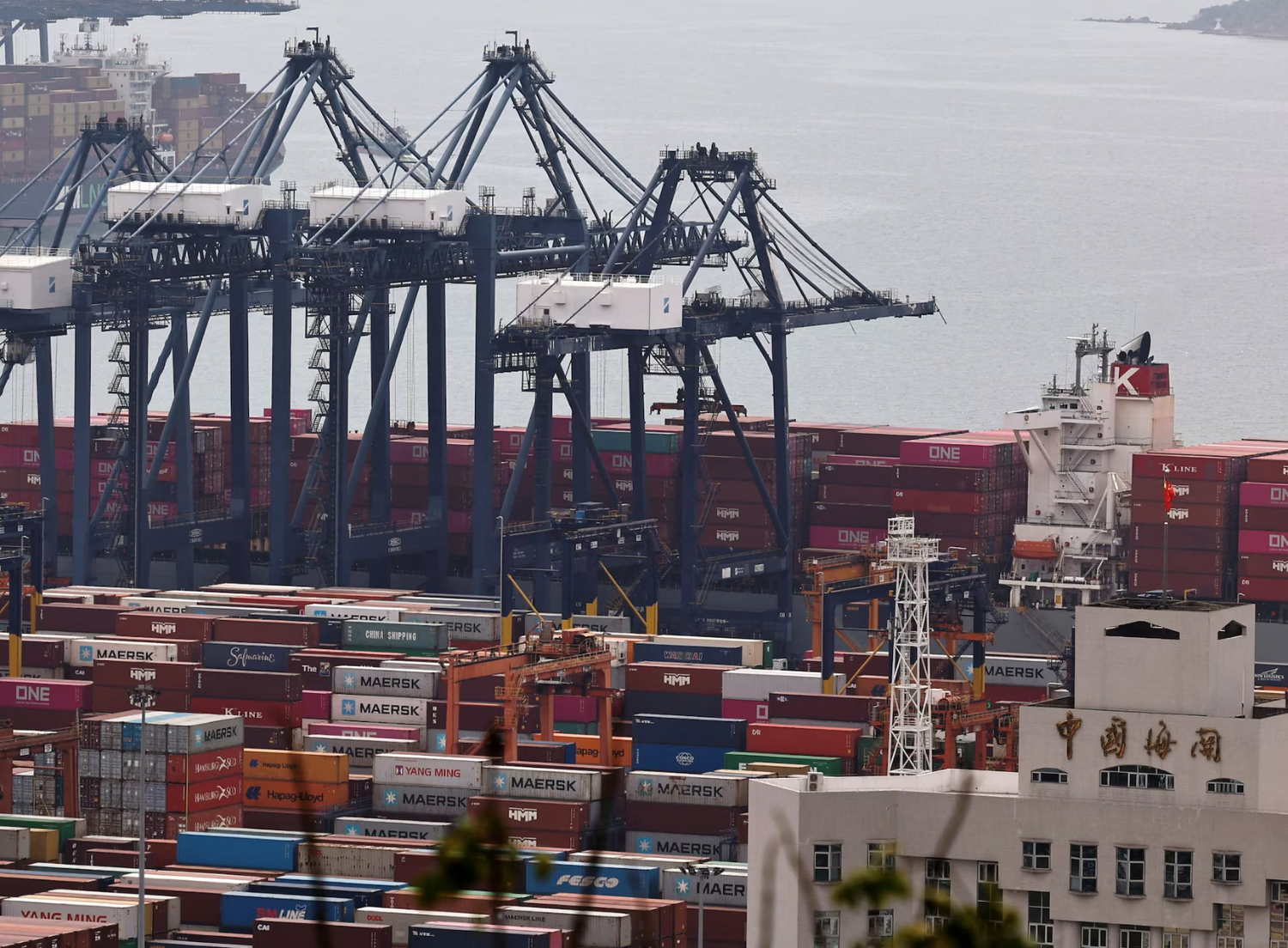
China's consumer price index rose 1.2% in April
Image Credit : Associated Press
Source Credit : Portfolio Prints
China’s producer prices rose at their fastest pace in more than three years in April, while consumer inflation also exceeded forecasts, as surging commodity costs linked to the Iran war and stronger holiday spending fueled a broader reflationary rebound in the economy.
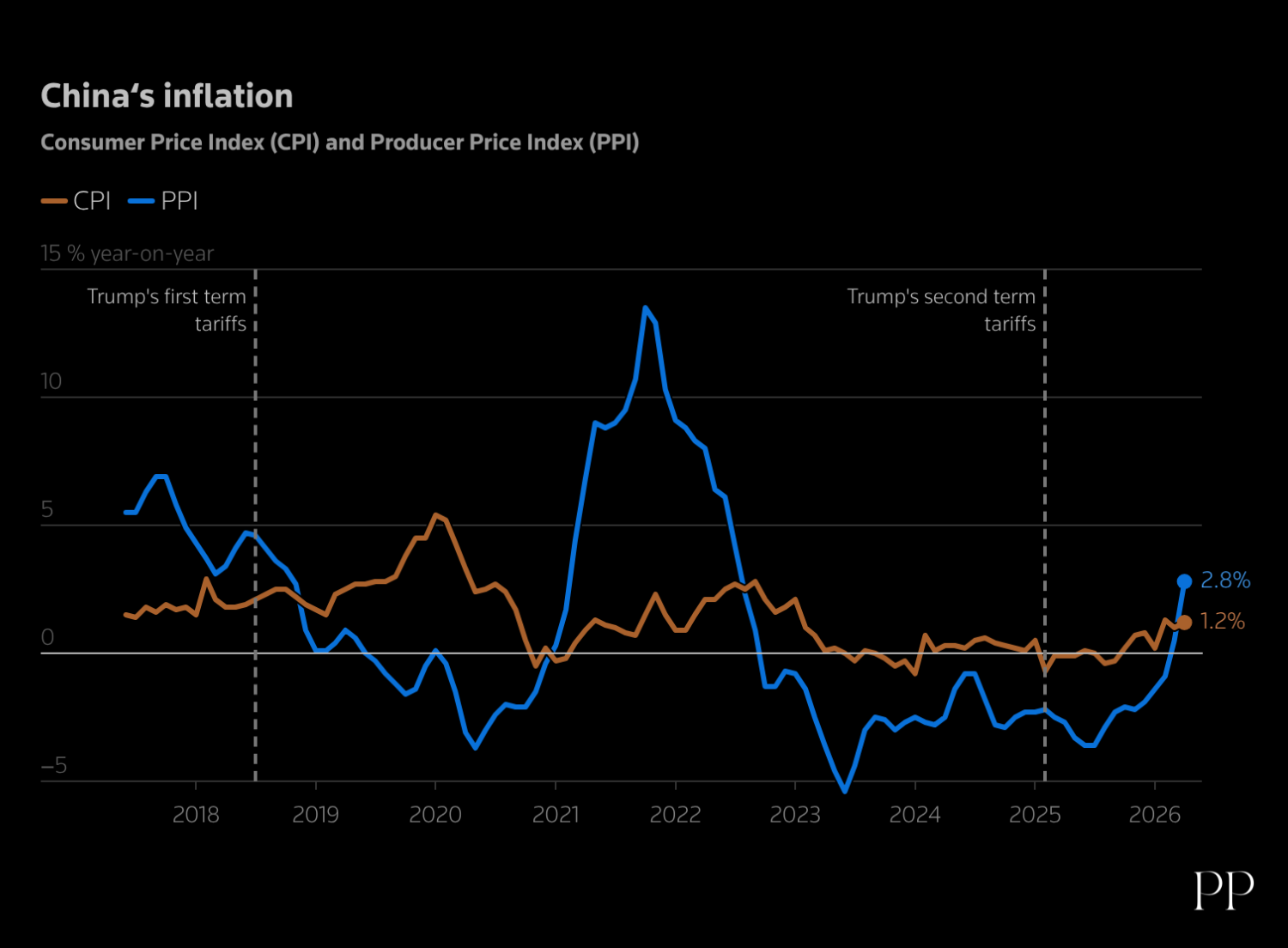
Consumer prices increased 1.2% in April from a year earlier, ahead of economists’ expectations for a 0.9% rise in a Reuters poll and accelerating from March’s 1% gain, according to data released Monday by the National Bureau of Statistics.
China’s producer price index climbed 2.8% year-on-year in April — the strongest increase since July 2022 — sharply beating economists’ forecasts for 1.6% growth and accelerating from just 0.5% in March, according to LSEG data.
The jump came after factory-gate prices returned to positive territory in March following three consecutive years of declines, ending the country’s longest producer deflation streak in decades.
Inflationary pressures have been amplified by rising global commodity prices as the Iran war continues to disrupt shipping through the Strait of Hormuz, constraining global flows of oil, gas and industrial raw materials.
Retail gasoline prices surged 19.3% from a year earlier in April, according to official figures, while food prices fell 1.6% due to lower pork and fresh produce costs. Core consumer inflation, which excludes volatile food and energy prices, rose 1.2% from a year earlier, edging up from 1.1% in March.
 Consumer inflation also received support from stronger travel and tourism spending during the Qingming Festival, Labour Day holidays and regional spring breaks.
Preliminary government data showed retail spending during the extended Labour Day holiday, which ended May 5, climbed 14.3% from a year earlier, surpassing the 13.7% increase recorded during February’s Lunar New Year holiday period.
The global energy shock triggered by the Strait of Hormuz blockade has rippled across China’s industrial economy, with prices in non-ferrous metals mining soaring 38.9% year-on-year and oil and gas extraction prices rising 28.6%.
Prices for oil and coal processing increased 14.2%, driven by stronger demand for power-generation coal and growing use of coal as an alternative fuel source in chemical and metallurgical industries.
Beyond commodity prices, producer inflation was also supported by booming demand for artificial intelligence infrastructure, which pushed up prices for fiber manufacturing and external storage equipment, while easing price competition across several industrial sectors, Dong Lijuan, chief statistician at the National Bureau of Statistics, said Monday.
“These reflationary forces could be welcomed by Beijing following three years of prolonged deflationary pressures,” Nomura analysts said. However, the bank warned that supply-driven inflation could further squeeze corporate profit margins and weigh on household consumption.
Domestic demand in China has remained uneven despite the stronger inflation figures. Retail sales growth slowed sharply to 1.7% in March, missing expectations, while the prolonged property downturn continued to drag on the economy.
Real estate investment fell 11.2% in the first quarter compared with a year earlier, worsening from the 9.9% decline recorded during the same period last year.
China, the world’s largest crude oil importer, has partially shielded itself from the worst of the global energy shock through large strategic petroleum reserves and an increasingly diversified renewable energy mix. Economists, however, caution that those buffers could weaken if disruptions persist.
Consumer inflation is expected to remain relatively contained, while the outlook for producer prices will largely depend on global oil markets in the near term and Beijing’s broader industrial reforms over the longer run, said Zhaopeng Xing, chief China strategist at ANZ Research. The bank forecasts full-year consumer inflation of 1.2%.
Separate data released Saturday showed China’s crude oil imports fell 20% in April by volume compared with a year earlier.
Despite weaker imports, China’s export sector remained resilient. Exports rose 14.1% year-on-year last month, pushing the monthly trade surplus to $84.8 billion and keeping the country on course for a third consecutive year of trade surpluses approaching $1 trillion.
China’s growing export strength, which has widened the country’s trade surplus with the United States to $87.7 billion so far this year, is expected to come under scrutiny next week as U.S. President Donald Trump prepares to visit Beijing for a leaders’ summit.
Chinese President Xi Jinping is scheduled to host Trump later this week as both governments attempt to stabilize relations strained by disputes over trade, export controls, Taiwan and the Iran war.
Beijing, which hosted Iranian Foreign Minister Abbas Araghchi last week, has increasingly positioned itself as a diplomatic intermediary in efforts to reopen the Strait of Hormuz, according to economists at Goldman Sachs, who expect the Middle East conflict to feature prominently during the summit.
The stronger inflation data and resilient export performance are likely to keep Chinese policymakers on hold until at least the second half of the year unless economic conditions deteriorate sharply, said Lynn Song, chief economist for Greater China at ING. He added that Beijing’s next policy adjustment is still more likely to be an interest rate cut rather than a hike.
Consumer inflation also received support from stronger travel and tourism spending during the Qingming Festival, Labour Day holidays and regional spring breaks.
Preliminary government data showed retail spending during the extended Labour Day holiday, which ended May 5, climbed 14.3% from a year earlier, surpassing the 13.7% increase recorded during February’s Lunar New Year holiday period.
The global energy shock triggered by the Strait of Hormuz blockade has rippled across China’s industrial economy, with prices in non-ferrous metals mining soaring 38.9% year-on-year and oil and gas extraction prices rising 28.6%.
Prices for oil and coal processing increased 14.2%, driven by stronger demand for power-generation coal and growing use of coal as an alternative fuel source in chemical and metallurgical industries.
Beyond commodity prices, producer inflation was also supported by booming demand for artificial intelligence infrastructure, which pushed up prices for fiber manufacturing and external storage equipment, while easing price competition across several industrial sectors, Dong Lijuan, chief statistician at the National Bureau of Statistics, said Monday.
“These reflationary forces could be welcomed by Beijing following three years of prolonged deflationary pressures,” Nomura analysts said. However, the bank warned that supply-driven inflation could further squeeze corporate profit margins and weigh on household consumption.
Domestic demand in China has remained uneven despite the stronger inflation figures. Retail sales growth slowed sharply to 1.7% in March, missing expectations, while the prolonged property downturn continued to drag on the economy.
Real estate investment fell 11.2% in the first quarter compared with a year earlier, worsening from the 9.9% decline recorded during the same period last year.
China, the world’s largest crude oil importer, has partially shielded itself from the worst of the global energy shock through large strategic petroleum reserves and an increasingly diversified renewable energy mix. Economists, however, caution that those buffers could weaken if disruptions persist.
Consumer inflation is expected to remain relatively contained, while the outlook for producer prices will largely depend on global oil markets in the near term and Beijing’s broader industrial reforms over the longer run, said Zhaopeng Xing, chief China strategist at ANZ Research. The bank forecasts full-year consumer inflation of 1.2%.
Separate data released Saturday showed China’s crude oil imports fell 20% in April by volume compared with a year earlier.
Despite weaker imports, China’s export sector remained resilient. Exports rose 14.1% year-on-year last month, pushing the monthly trade surplus to $84.8 billion and keeping the country on course for a third consecutive year of trade surpluses approaching $1 trillion.
China’s growing export strength, which has widened the country’s trade surplus with the United States to $87.7 billion so far this year, is expected to come under scrutiny next week as U.S. President Donald Trump prepares to visit Beijing for a leaders’ summit.
Chinese President Xi Jinping is scheduled to host Trump later this week as both governments attempt to stabilize relations strained by disputes over trade, export controls, Taiwan and the Iran war.
Beijing, which hosted Iranian Foreign Minister Abbas Araghchi last week, has increasingly positioned itself as a diplomatic intermediary in efforts to reopen the Strait of Hormuz, according to economists at Goldman Sachs, who expect the Middle East conflict to feature prominently during the summit.
The stronger inflation data and resilient export performance are likely to keep Chinese policymakers on hold until at least the second half of the year unless economic conditions deteriorate sharply, said Lynn Song, chief economist for Greater China at ING. He added that Beijing’s next policy adjustment is still more likely to be an interest rate cut rather than a hike.