China's economy loses steam at start of April
Image Credit : EPA Photo
Source Credit : Portfolio Prints
China’s economic recovery lost momentum in April as industrial output slowed sharply and consumer spending weakened to its lowest level in more than three years, underscoring mounting pressure from rising energy costs linked to the Iran conflict and persistently fragile domestic demand.
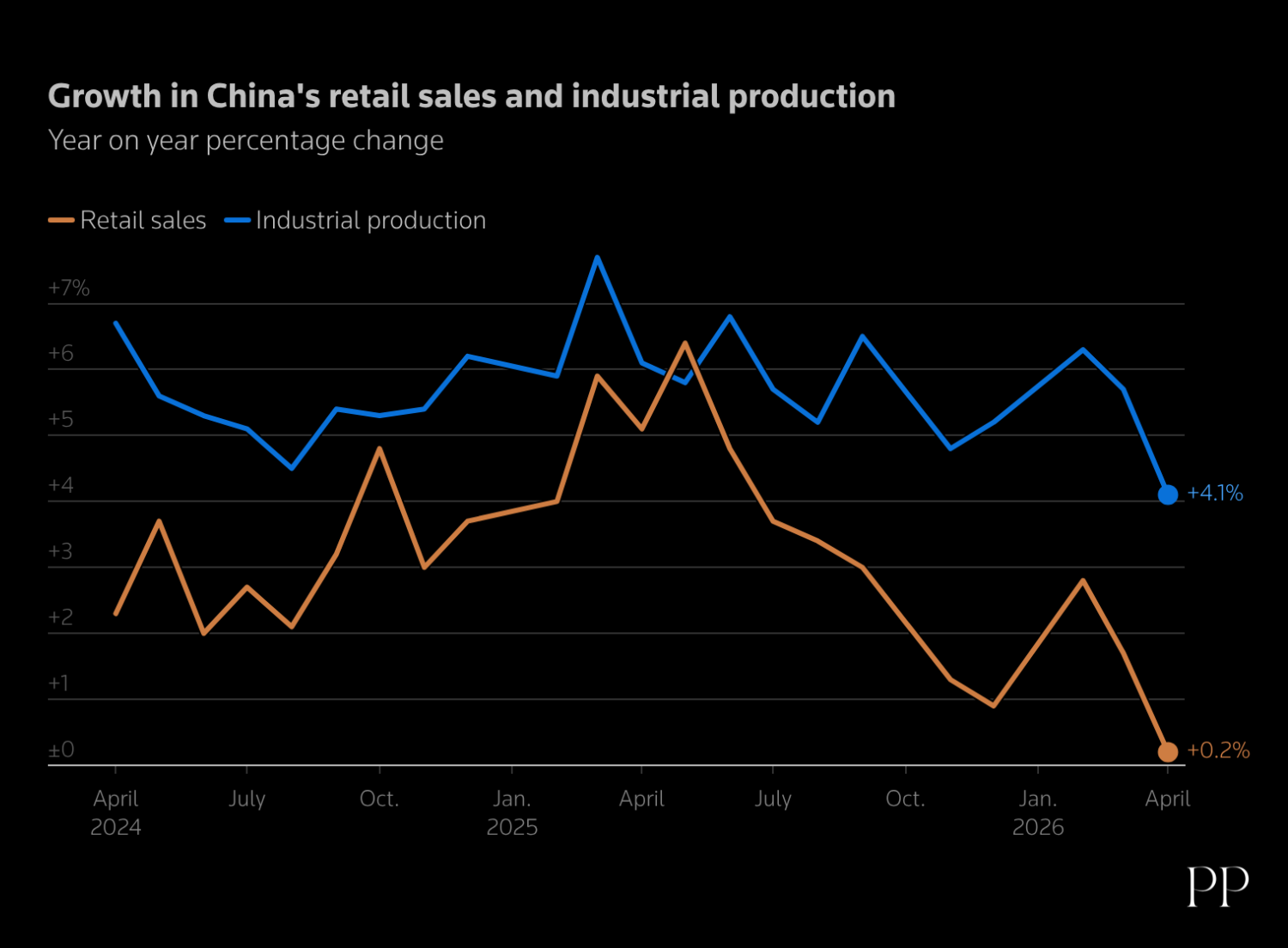
Data released Monday by China’s National Bureau of Statistics (NBS) showed industrial production grew 4.1% year-on-year in April, slowing from 5.7% in March and missing Reuters expectations for 5.9% growth. It marked the weakest expansion since July 2023.
Economists said stronger exports helped cushion the slowdown, but not enough to offset weak household spending and soft investment activity at home.
“The strong performance of exporters helped mitigate weaknesses in domestic demand, but not enough to fully offset them,” said Zhiwei Zhang, president and chief economist at Pinpoint Asset Management.
Chinese exports accelerated in April as manufacturers rushed to fulfil orders tied to AI-related industries and overseas buyers stockpiled components amid concerns that the Iran war could drive global production costs even higher.
Despite the weak data, analysts believe Beijing is unlikely to shift policy immediately. Zhang said Chinese policymakers will probably wait for second-quarter GDP figures in July before reassessing the economic outlook.
Retail sales — a key gauge of consumer demand — rose just 0.2% in April, down sharply from 1.7% growth in March and the weakest reading since December 2022. The figure also fell far short of market expectations for a 2% increase.
 The weakness in household spending was especially visible in the auto sector. Domestic car sales dropped 21.6% from a year earlier, marking a seventh straight month of decline, even as Chinese automakers increasingly turn to overseas markets to offset sluggish demand at home.
“Retail sales growth in the first four months of 2026 points to still-weak household demand,” said Yuhan Zhang, principal economist at the Conference Board China Center.
He said consumers remain willing to spend selectively on lifestyle and technology upgrades, but demand for larger, credit-driven purchases tied to housing and income confidence remains subdued.
One of the few brighter spots in the report was the labour market, with China’s nationwide survey-based unemployment rate easing slightly to 5.2% in April from 5.4% in March.
However, investment activity deteriorated further. Fixed-asset investment (FAI) contracted 1.6% in the first four months of 2026, reversing a 1.7% increase recorded in the January-March period and missing forecasts for modest growth.
Domestic crude steel production also reflected the slowdown, falling 2.8% year-on-year as weaker construction and industrial activity weighed on demand.
Lisheng Wang of Goldman Sachs said weaker credit demand and severe rainfall in southern China may have contributed to the decline in investment activity, while warning that occasional statistical revisions by the NBS may have exaggerated the volatility in the data.
Chinese stocks were broadly flat after the release, as investors focused instead on escalating tensions in the Middle East and a wider global bond market selloff.
The April data added to concerns that China’s strong first-quarter growth momentum is already fading. The figures were released shortly after U.S. President Donald Trump concluded a state visit to China aimed at stabilising relations between the world’s two largest economies.
Although both sides agreed to expand agricultural trade through tariff reductions and improve market access, analysts said the summit delivered little substantive progress on broader trade and investment disputes.
Chinese leaders have increasingly focused on strengthening energy security, boosting technological self-sufficiency and tightening control over supply chains as geopolitical risks intensify.
China’s economy grew 5.0% in the first quarter of 2026, placing growth at the upper end of Beijing’s official full-year target range of 4.5% to 5.0%. Still, economists warn the recovery remains uneven, with industrial production continuing to outpace domestic demand.
The country’s prolonged property downturn also remains a major drag on growth, while the conflict in the Middle East has heightened external risks at a time when consumer confidence remains fragile.
Property investment declines deepened further in April, although new home prices fell at their slowest monthly pace in a year, suggesting tentative signs of stabilisation as local governments roll out measures to support the housing market.
ING warned that China may face a broader slowdown in the second quarter after April’s weak start.
“Weaker growth and rising inflation could complicate policymaking in the coming months,” said Lynn Song, ING’s chief China economist.
“We’ve seen limited urgency for stimulus so far this year, but if the data continue to deteriorate, that could change quickly.”
The weakness in household spending was especially visible in the auto sector. Domestic car sales dropped 21.6% from a year earlier, marking a seventh straight month of decline, even as Chinese automakers increasingly turn to overseas markets to offset sluggish demand at home.
“Retail sales growth in the first four months of 2026 points to still-weak household demand,” said Yuhan Zhang, principal economist at the Conference Board China Center.
He said consumers remain willing to spend selectively on lifestyle and technology upgrades, but demand for larger, credit-driven purchases tied to housing and income confidence remains subdued.
One of the few brighter spots in the report was the labour market, with China’s nationwide survey-based unemployment rate easing slightly to 5.2% in April from 5.4% in March.
However, investment activity deteriorated further. Fixed-asset investment (FAI) contracted 1.6% in the first four months of 2026, reversing a 1.7% increase recorded in the January-March period and missing forecasts for modest growth.
Domestic crude steel production also reflected the slowdown, falling 2.8% year-on-year as weaker construction and industrial activity weighed on demand.
Lisheng Wang of Goldman Sachs said weaker credit demand and severe rainfall in southern China may have contributed to the decline in investment activity, while warning that occasional statistical revisions by the NBS may have exaggerated the volatility in the data.
Chinese stocks were broadly flat after the release, as investors focused instead on escalating tensions in the Middle East and a wider global bond market selloff.
The April data added to concerns that China’s strong first-quarter growth momentum is already fading. The figures were released shortly after U.S. President Donald Trump concluded a state visit to China aimed at stabilising relations between the world’s two largest economies.
Although both sides agreed to expand agricultural trade through tariff reductions and improve market access, analysts said the summit delivered little substantive progress on broader trade and investment disputes.
Chinese leaders have increasingly focused on strengthening energy security, boosting technological self-sufficiency and tightening control over supply chains as geopolitical risks intensify.
China’s economy grew 5.0% in the first quarter of 2026, placing growth at the upper end of Beijing’s official full-year target range of 4.5% to 5.0%. Still, economists warn the recovery remains uneven, with industrial production continuing to outpace domestic demand.
The country’s prolonged property downturn also remains a major drag on growth, while the conflict in the Middle East has heightened external risks at a time when consumer confidence remains fragile.
Property investment declines deepened further in April, although new home prices fell at their slowest monthly pace in a year, suggesting tentative signs of stabilisation as local governments roll out measures to support the housing market.
ING warned that China may face a broader slowdown in the second quarter after April’s weak start.
“Weaker growth and rising inflation could complicate policymaking in the coming months,” said Lynn Song, ING’s chief China economist.
“We’ve seen limited urgency for stimulus so far this year, but if the data continue to deteriorate, that could change quickly.”