U.S. debt has topped $40 trillion for the first time
Image Credit : Reuters
Source Credit : Portfolio Prints
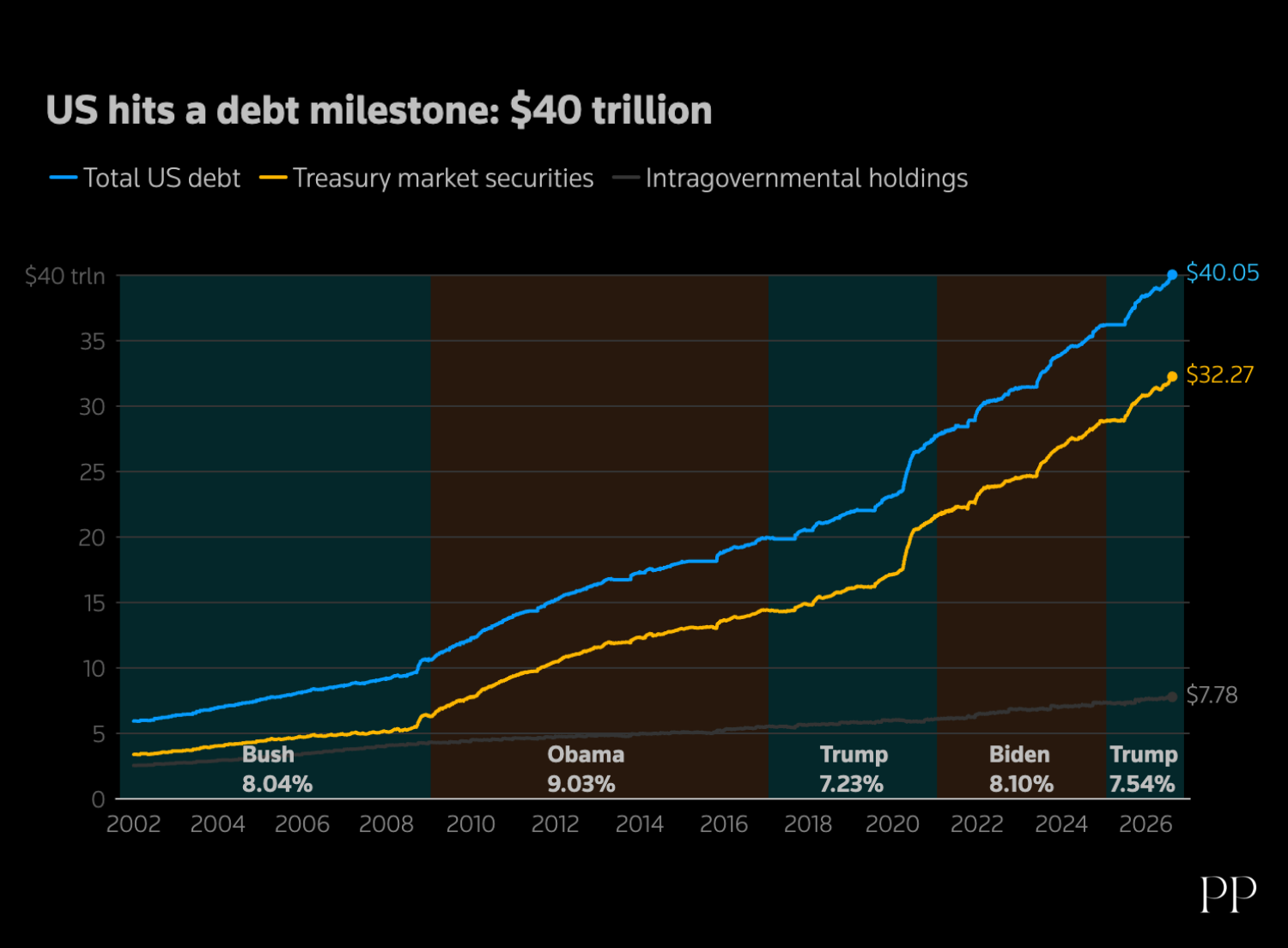
The U.S. national debt has surpassed $40 trillion for the first time, marking a historic milestone that is renewing concerns over the country’s worsening fiscal position. The Treasury Department’s latest daily cash and debt statement showed total public debt outstanding at $40.047 trillion on Tuesday, underscoring the scale of borrowing needed to finance the federal government.
Of the total, $32.266 trillion is debt held by the public, while $7.782 trillion consists of intragovernmental holdings. The milestone comes as the federal government faces a widening gap between revenues and expenditures, with rising spending on Social Security, Medicare and other mandatory programs occurring alongside rapidly increasing interest costs.
The U.S. debt burden has more than doubled in less than a decade. When Donald Trump first took office in January 2017, federal debt stood at roughly $19.95 trillion. About one-third of the subsequent increase accumulated during the extraordinary borrowing undertaken to finance the COVID-19 pandemic response under Trump and Joe Biden. The remainder reflects a combination of tax policy, spending decisions and long-standing structural imbalances between federal revenues and expenditures.
 Fiscal watchdogs have warned for years that the trajectory is becoming increasingly difficult to sustain. Maya MacGuineas, president of the nonpartisan Committee for a Responsible Federal Budget, said the $40 trillion milestone should not be viewed simply as a number on the government’s balance sheet because the consequences ultimately spread throughout the broader economy.
As the government borrows more, debt-servicing costs consume a larger share of federal resources, potentially limiting spending on other priorities. Heavy borrowing can also increase pressure on interest rates and leave the government with less fiscal flexibility to respond to future economic downturns, financial shocks or national emergencies.
The speed at which the debt has risen is particularly striking. The $40 trillion threshold was reached less than five months after federal debt crossed $39 trillion. It has also quadrupled in less than two decades, compared with the nearly 200 years it took for U.S. debt to reach its first $1 trillion in 1981.
The bond market is already reflecting some of these concerns. Foreign investors, who hold a significant share of outstanding U.S. Treasury securities, have shown weaker demand over the past year. At the same time, yields on longer-dated Treasuries have climbed sharply as investors demand greater compensation for holding government debt amid heavy issuance and growing fiscal uncertainty.
A recent $25 billion auction of 30-year Treasury bonds produced the highest yield since 2021. Long-term Treasury yields subsequently reached their highest levels in nearly two decades, highlighting investor concerns about the supply of government debt and the long-term fiscal outlook.
Higher long-term Treasury yields matter well beyond government borrowing. Treasury yields serve as a benchmark for a wide range of borrowing costs across the economy, including mortgages, automobile loans and commercial credit. If long-term yields remain elevated, households and businesses could face higher financing costs, potentially weighing on investment and economic growth.
The Treasury has responded with measures aimed at supporting liquidity in the longer-dated Treasury market. Treasury Secretary Scott Bessent announced that the government would double the size of its buyback operations for 10- to 30-year Treasury securities to at least $4 billion per operation, a move designed in part to improve market functioning and help manage Treasury supply.
President Trump has repeatedly called for lower interest rates, arguing that a strong U.S. economy should ultimately translate into cheaper borrowing costs. But the Federal Reserve’s ability to lower rates does not directly resolve the government's underlying fiscal problem. Even if short-term rates decline, the sheer volume of outstanding debt means interest expenses can continue to rise as older securities mature and are refinanced.
The scale of the fiscal imbalance was evident in the government's July figures. The federal deficit reached $432 billion during the month, one of the largest monthly shortfalls ever recorded. Tariff-related refunds pushed customs receipts into negative territory for the third consecutive month, while spending on Social Security and Medicare continued to increase.
After the first 10 months of fiscal 2026, the federal deficit had already exceeded the total deficit recorded during the entire 2025 fiscal year, with two months still remaining in the fiscal year. The figures highlight the difficulty of containing the deficit when major components of federal spending continue to grow automatically.
Fiscal watchdogs have warned for years that the trajectory is becoming increasingly difficult to sustain. Maya MacGuineas, president of the nonpartisan Committee for a Responsible Federal Budget, said the $40 trillion milestone should not be viewed simply as a number on the government’s balance sheet because the consequences ultimately spread throughout the broader economy.
As the government borrows more, debt-servicing costs consume a larger share of federal resources, potentially limiting spending on other priorities. Heavy borrowing can also increase pressure on interest rates and leave the government with less fiscal flexibility to respond to future economic downturns, financial shocks or national emergencies.
The speed at which the debt has risen is particularly striking. The $40 trillion threshold was reached less than five months after federal debt crossed $39 trillion. It has also quadrupled in less than two decades, compared with the nearly 200 years it took for U.S. debt to reach its first $1 trillion in 1981.
The bond market is already reflecting some of these concerns. Foreign investors, who hold a significant share of outstanding U.S. Treasury securities, have shown weaker demand over the past year. At the same time, yields on longer-dated Treasuries have climbed sharply as investors demand greater compensation for holding government debt amid heavy issuance and growing fiscal uncertainty.
A recent $25 billion auction of 30-year Treasury bonds produced the highest yield since 2021. Long-term Treasury yields subsequently reached their highest levels in nearly two decades, highlighting investor concerns about the supply of government debt and the long-term fiscal outlook.
Higher long-term Treasury yields matter well beyond government borrowing. Treasury yields serve as a benchmark for a wide range of borrowing costs across the economy, including mortgages, automobile loans and commercial credit. If long-term yields remain elevated, households and businesses could face higher financing costs, potentially weighing on investment and economic growth.
The Treasury has responded with measures aimed at supporting liquidity in the longer-dated Treasury market. Treasury Secretary Scott Bessent announced that the government would double the size of its buyback operations for 10- to 30-year Treasury securities to at least $4 billion per operation, a move designed in part to improve market functioning and help manage Treasury supply.
President Trump has repeatedly called for lower interest rates, arguing that a strong U.S. economy should ultimately translate into cheaper borrowing costs. But the Federal Reserve’s ability to lower rates does not directly resolve the government's underlying fiscal problem. Even if short-term rates decline, the sheer volume of outstanding debt means interest expenses can continue to rise as older securities mature and are refinanced.
The scale of the fiscal imbalance was evident in the government's July figures. The federal deficit reached $432 billion during the month, one of the largest monthly shortfalls ever recorded. Tariff-related refunds pushed customs receipts into negative territory for the third consecutive month, while spending on Social Security and Medicare continued to increase.
After the first 10 months of fiscal 2026, the federal deficit had already exceeded the total deficit recorded during the entire 2025 fiscal year, with two months still remaining in the fiscal year. The figures highlight the difficulty of containing the deficit when major components of federal spending continue to grow automatically.
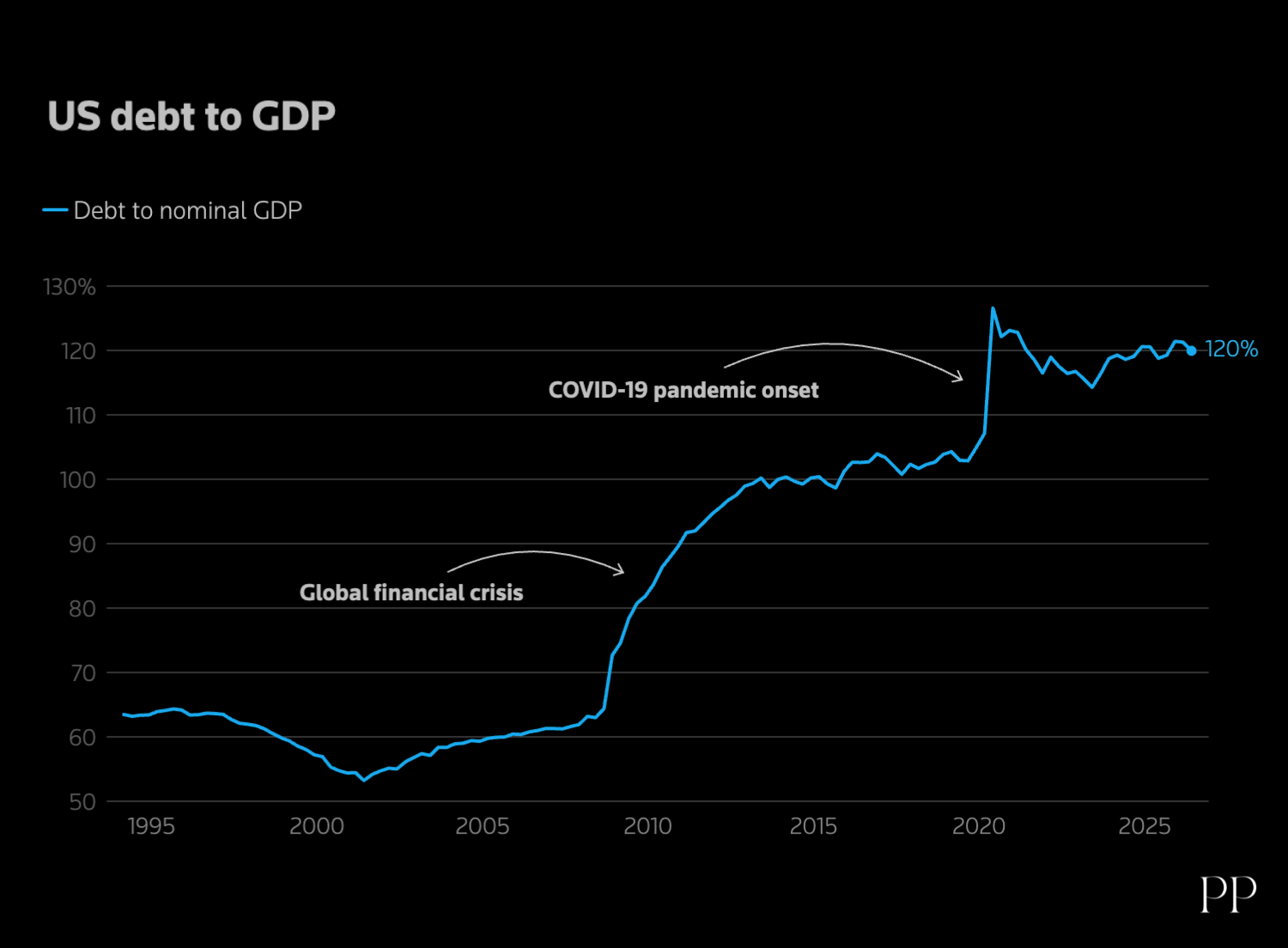 The trajectory of U.S. debt has also accelerated under successive administrations. Federal debt increased by roughly $7.8 trillion during Trump's first term, with more than half of that increase occurring during the final months of his presidency as the government responded to the COVID-19 crisis.
Under Biden, federal debt increased by approximately $8.4 trillion. While pandemic-related spending remained an important factor, additional borrowing also reflected spending on infrastructure, clean-energy incentives and other major policy initiatives.
Since Trump returned to office in January 2025, the national debt has increased by another $3.8 trillion. Taken together, the increase across Trump's two terms has reached roughly $11.6 trillion.
The bipartisan nature of the increase is important because the country's fiscal problem extends beyond any single administration. The Committee for a Responsible Federal Budget estimates that policy decisions made under both Trump and Biden have pushed the debt trajectory above what would have occurred under existing spending laws at the time each president took office.
Trump's second-term legislative agenda has also raised concerns among fiscal conservatives. His One Big Beautiful Bill Act is projected by the Congressional Budget Office to add approximately $4.7 trillion to federal debt, further complicating efforts to stabilize the government's finances.
At the same time, Trump's administration has pursued spending reductions through federal agency cuts and efforts associated with the Department of Government Efficiency. However, many of these reductions have focused on discretionary spending, which represents a relatively small portion of the overall federal budget.
The fundamental challenge lies in the structure of federal spending. The U.S. government spends roughly $7 trillion a year, with around 60% allocated to mandatory programs such as Social Security, Medicare, Medicaid and veterans' benefits. These programs are largely driven by eligibility rules and demographic trends rather than annual discretionary decisions.
Interest payments have become another increasingly significant burden. The federal government is now spending roughly $1.1 trillion a year servicing its debt. In fiscal 2025, annual interest costs surpassed Pentagon spending for the first time. During the first 10 months of fiscal 2026, interest expenses also exceeded Medicare spending, making debt service the second-largest federal budget category after Social Security.
The underlying demographic pressures are unlikely to disappear. The aging of the baby-boom generation is increasing demand for retirement and healthcare benefits at the same time that the tax base is struggling to generate enough revenue to cover the government's growing commitments.
Social Security and Medicare face particularly significant long-term pressures because their costs are closely linked to an aging population. As more Americans retire and live longer, the number of beneficiaries is increasing relative to the number of workers paying payroll taxes.
This creates a difficult policy dilemma. Raising taxes could generate additional revenue but risks slowing economic activity and faces strong political opposition. Cutting spending could improve the fiscal outlook but would require difficult decisions involving programs that millions of Americans depend on. Allowing deficits to remain elevated, meanwhile, would continue pushing the debt higher and increase the government's exposure to rising interest rates.
The $40 trillion milestone therefore represents more than a symbolic number. It reflects a deeper structural problem in which federal spending commitments are consistently exceeding revenues. Unless policymakers address the underlying imbalance, debt is likely to continue growing regardless of which political party controls the White House or Congress.
The immediate consequences may not necessarily resemble a sudden sovereign debt crisis. The United States retains significant advantages, including the dollar's role as the world's dominant reserve currency and the Treasury market's central position in the global financial system. These factors give Washington considerably more borrowing capacity than most governments.
But those advantages do not eliminate the cost of persistent fiscal deterioration. Rising interest payments can gradually crowd out other government priorities, higher bond yields can increase borrowing costs throughout the economy, and weaker investor demand could make financing future deficits increasingly expensive.
The central question is therefore no longer whether U.S. debt will continue to rise, but how quickly it will do so and whether policymakers can eventually stabilize the trajectory. Crossing $40 trillion is a stark reminder that the fiscal choices made today will increasingly shape the economic flexibility available to the United States in the years ahead.
The trajectory of U.S. debt has also accelerated under successive administrations. Federal debt increased by roughly $7.8 trillion during Trump's first term, with more than half of that increase occurring during the final months of his presidency as the government responded to the COVID-19 crisis.
Under Biden, federal debt increased by approximately $8.4 trillion. While pandemic-related spending remained an important factor, additional borrowing also reflected spending on infrastructure, clean-energy incentives and other major policy initiatives.
Since Trump returned to office in January 2025, the national debt has increased by another $3.8 trillion. Taken together, the increase across Trump's two terms has reached roughly $11.6 trillion.
The bipartisan nature of the increase is important because the country's fiscal problem extends beyond any single administration. The Committee for a Responsible Federal Budget estimates that policy decisions made under both Trump and Biden have pushed the debt trajectory above what would have occurred under existing spending laws at the time each president took office.
Trump's second-term legislative agenda has also raised concerns among fiscal conservatives. His One Big Beautiful Bill Act is projected by the Congressional Budget Office to add approximately $4.7 trillion to federal debt, further complicating efforts to stabilize the government's finances.
At the same time, Trump's administration has pursued spending reductions through federal agency cuts and efforts associated with the Department of Government Efficiency. However, many of these reductions have focused on discretionary spending, which represents a relatively small portion of the overall federal budget.
The fundamental challenge lies in the structure of federal spending. The U.S. government spends roughly $7 trillion a year, with around 60% allocated to mandatory programs such as Social Security, Medicare, Medicaid and veterans' benefits. These programs are largely driven by eligibility rules and demographic trends rather than annual discretionary decisions.
Interest payments have become another increasingly significant burden. The federal government is now spending roughly $1.1 trillion a year servicing its debt. In fiscal 2025, annual interest costs surpassed Pentagon spending for the first time. During the first 10 months of fiscal 2026, interest expenses also exceeded Medicare spending, making debt service the second-largest federal budget category after Social Security.
The underlying demographic pressures are unlikely to disappear. The aging of the baby-boom generation is increasing demand for retirement and healthcare benefits at the same time that the tax base is struggling to generate enough revenue to cover the government's growing commitments.
Social Security and Medicare face particularly significant long-term pressures because their costs are closely linked to an aging population. As more Americans retire and live longer, the number of beneficiaries is increasing relative to the number of workers paying payroll taxes.
This creates a difficult policy dilemma. Raising taxes could generate additional revenue but risks slowing economic activity and faces strong political opposition. Cutting spending could improve the fiscal outlook but would require difficult decisions involving programs that millions of Americans depend on. Allowing deficits to remain elevated, meanwhile, would continue pushing the debt higher and increase the government's exposure to rising interest rates.
The $40 trillion milestone therefore represents more than a symbolic number. It reflects a deeper structural problem in which federal spending commitments are consistently exceeding revenues. Unless policymakers address the underlying imbalance, debt is likely to continue growing regardless of which political party controls the White House or Congress.
The immediate consequences may not necessarily resemble a sudden sovereign debt crisis. The United States retains significant advantages, including the dollar's role as the world's dominant reserve currency and the Treasury market's central position in the global financial system. These factors give Washington considerably more borrowing capacity than most governments.
But those advantages do not eliminate the cost of persistent fiscal deterioration. Rising interest payments can gradually crowd out other government priorities, higher bond yields can increase borrowing costs throughout the economy, and weaker investor demand could make financing future deficits increasingly expensive.
The central question is therefore no longer whether U.S. debt will continue to rise, but how quickly it will do so and whether policymakers can eventually stabilize the trajectory. Crossing $40 trillion is a stark reminder that the fiscal choices made today will increasingly shape the economic flexibility available to the United States in the years ahead.