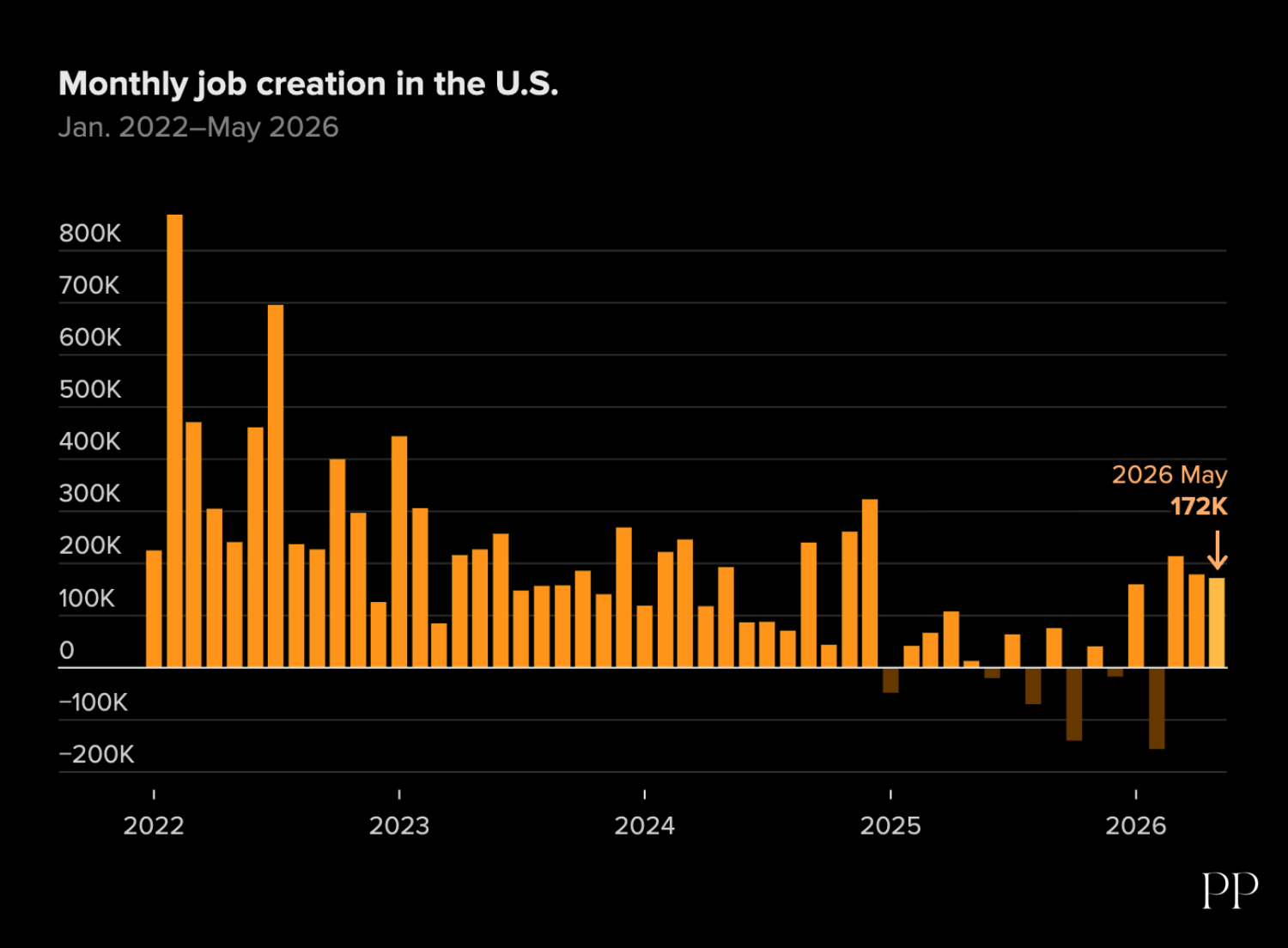
U.S. employers added 172,000 jobs in May
Image Credit : Bloomberg
Source Credit : Portfolio Prints
The U.S. labor market delivered another upside surprise in May, underscoring the economy's resilience despite persistent inflationary pressures and elevated borrowing costs.
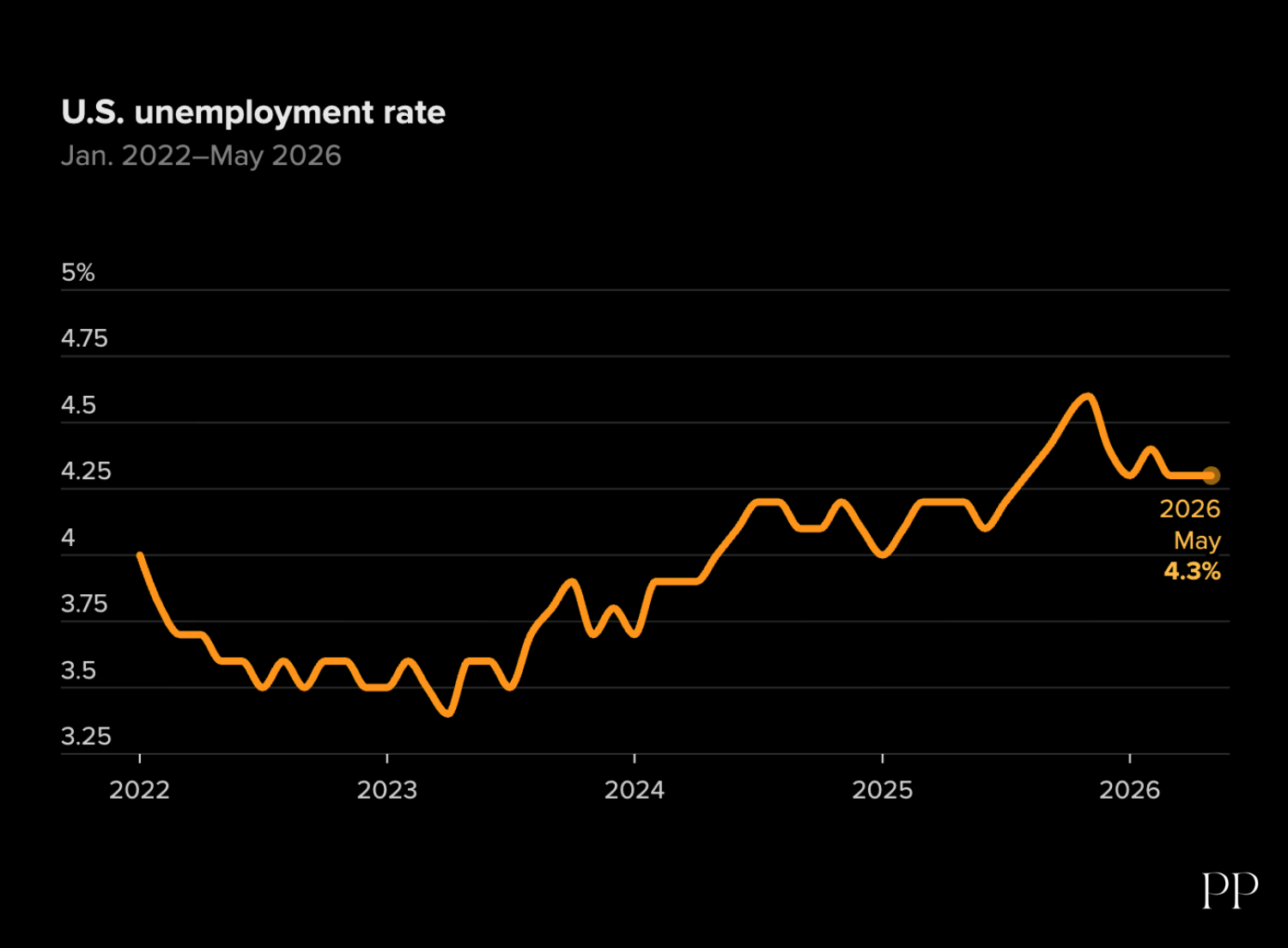
According to data released Friday by the Bureau of Labor Statistics (BLS), nonfarm payrolls increased by 172,000 jobs in May, comfortably exceeding economists' expectations of 80,000. While the figure was slightly below April's upwardly revised gain of 179,000, it reinforced the narrative of a labor market that continues to expand at a healthy pace. The unemployment rate remained unchanged at 4.3%, matching forecasts.
 “This is a labor market that is stronger than it was last year and is looking pretty darn solid, despite high energy prices and higher inflation generally,” said Gus Faucher, Chief Economist at PNC. “There’s no indication that the labor market needs support.”
The strength of hiring was broadly distributed across industries, signaling an improvement in the breadth of job creation.
The leisure and hospitality sector led the gains, adding 70,000 jobs during the month—far above its average monthly increase of 14,000 over the past year. Economists suggested part of the surge may reflect staffing needs associated with preparations for the upcoming World Cup.
Local government employment rose by 55,000 positions, while the healthcare sector, one of the most consistent drivers of job growth in recent years, added another 35,000 jobs. Social assistance contributed an additional 12,000 positions.
Wage growth remained steady, suggesting a balanced labor market. Average hourly earnings increased 0.3% in May and were up 3.4% from a year earlier, both in line with Wall Street expectations.
The report arrives amid concerns that employers have become increasingly cautious in a "low-hire, low-fire" environment. While hiring has been concentrated in a handful of sectors, layoffs have remained relatively subdued. At the same time, analysts continue to monitor signs that artificial intelligence and automation may be beginning to reshape workforce dynamics.
Adding to the report's positive tone, revisions to previous months revealed stronger labor market momentum than initially reported. April payroll growth was revised higher by 64,000 jobs, while March employment gains were boosted by 29,000 to 214,000.
“This is a labor market that is stronger than it was last year and is looking pretty darn solid, despite high energy prices and higher inflation generally,” said Gus Faucher, Chief Economist at PNC. “There’s no indication that the labor market needs support.”
The strength of hiring was broadly distributed across industries, signaling an improvement in the breadth of job creation.
The leisure and hospitality sector led the gains, adding 70,000 jobs during the month—far above its average monthly increase of 14,000 over the past year. Economists suggested part of the surge may reflect staffing needs associated with preparations for the upcoming World Cup.
Local government employment rose by 55,000 positions, while the healthcare sector, one of the most consistent drivers of job growth in recent years, added another 35,000 jobs. Social assistance contributed an additional 12,000 positions.
Wage growth remained steady, suggesting a balanced labor market. Average hourly earnings increased 0.3% in May and were up 3.4% from a year earlier, both in line with Wall Street expectations.
The report arrives amid concerns that employers have become increasingly cautious in a "low-hire, low-fire" environment. While hiring has been concentrated in a handful of sectors, layoffs have remained relatively subdued. At the same time, analysts continue to monitor signs that artificial intelligence and automation may be beginning to reshape workforce dynamics.
Adding to the report's positive tone, revisions to previous months revealed stronger labor market momentum than initially reported. April payroll growth was revised higher by 64,000 jobs, while March employment gains were boosted by 29,000 to 214,000.
 Last summer, President Donald Trump replaced the BLS commissioner following a series of disappointing employment reports and significant downward revisions, appointing William J. Wiatrowski as acting commissioner.
“The hiring recession is over. American firms are hiring again,” said Heather Long, Chief Economist at Navy Federal Credit Union. “This is a strong jobs report from every angle.”
Financial markets reacted swiftly to the data. Treasury yields climbed sharply as investors reassessed the likelihood of near-term Federal Reserve rate cuts, while stock futures traded mostly lower following the release.
The household survey, which is used to calculate the unemployment rate, also painted a picture of labor market resilience. Employment increased by 149,000 during the month, while the labor force participation rate held steady at 61.8%. A broader measure of unemployment—which includes discouraged workers and individuals working part-time for economic reasons—edged down to 8.1%.
The stronger-than-expected employment figures are likely to reinforce the Federal Reserve’s cautious approach to monetary policy.
“More solid jobs data leaves the Fed where it’s been for a while—watching and waiting, focused on the inflation side of its mandate,” said Ellen Zentner, Chief Economic Strategist at Morgan Stanley Wealth Management. “Rate cuts still aren’t on the near-term horizon, but the absence of inflationary threats in today’s report should quiet some of the chatter about a potential hike.”
In recent weeks, Federal Reserve officials have expressed growing confidence in the labor market while shifting their attention toward the more persistent challenge of inflation. That focus has effectively pushed expectations for additional rate cuts further into the future.
The central bank has maintained a holding pattern throughout 2026 after reducing benchmark interest rates by a cumulative three-quarters of a percentage point during the latter half of 2025. Policymakers have repeatedly emphasized the need for patience, signaling they will assess incoming economic data before committing to any further policy adjustments.
Meanwhile, broader economic activity continues to show resilience. U.S. gross domestic product expanded at an annualized rate of 1.6% in the first quarter, while the Atlanta Federal Reserve's GDPNow tracker currently projects growth of approximately 3% in the second quarter.
Taken together, the latest jobs report suggests that the U.S. economy remains on solid footing, with a healthy labor market providing a crucial buffer against inflationary pressures, geopolitical uncertainties, and tighter financial conditions. While investors continue to search for clues about the Federal Reserve's next move, May's employment data offers little evidence that policymakers need to rush toward easing monetary policy.
Last summer, President Donald Trump replaced the BLS commissioner following a series of disappointing employment reports and significant downward revisions, appointing William J. Wiatrowski as acting commissioner.
“The hiring recession is over. American firms are hiring again,” said Heather Long, Chief Economist at Navy Federal Credit Union. “This is a strong jobs report from every angle.”
Financial markets reacted swiftly to the data. Treasury yields climbed sharply as investors reassessed the likelihood of near-term Federal Reserve rate cuts, while stock futures traded mostly lower following the release.
The household survey, which is used to calculate the unemployment rate, also painted a picture of labor market resilience. Employment increased by 149,000 during the month, while the labor force participation rate held steady at 61.8%. A broader measure of unemployment—which includes discouraged workers and individuals working part-time for economic reasons—edged down to 8.1%.
The stronger-than-expected employment figures are likely to reinforce the Federal Reserve’s cautious approach to monetary policy.
“More solid jobs data leaves the Fed where it’s been for a while—watching and waiting, focused on the inflation side of its mandate,” said Ellen Zentner, Chief Economic Strategist at Morgan Stanley Wealth Management. “Rate cuts still aren’t on the near-term horizon, but the absence of inflationary threats in today’s report should quiet some of the chatter about a potential hike.”
In recent weeks, Federal Reserve officials have expressed growing confidence in the labor market while shifting their attention toward the more persistent challenge of inflation. That focus has effectively pushed expectations for additional rate cuts further into the future.
The central bank has maintained a holding pattern throughout 2026 after reducing benchmark interest rates by a cumulative three-quarters of a percentage point during the latter half of 2025. Policymakers have repeatedly emphasized the need for patience, signaling they will assess incoming economic data before committing to any further policy adjustments.
Meanwhile, broader economic activity continues to show resilience. U.S. gross domestic product expanded at an annualized rate of 1.6% in the first quarter, while the Atlanta Federal Reserve's GDPNow tracker currently projects growth of approximately 3% in the second quarter.
Taken together, the latest jobs report suggests that the U.S. economy remains on solid footing, with a healthy labor market providing a crucial buffer against inflationary pressures, geopolitical uncertainties, and tighter financial conditions. While investors continue to search for clues about the Federal Reserve's next move, May's employment data offers little evidence that policymakers need to rush toward easing monetary policy.